
The Polymega Remix Is the First "Buy It at Best Buy" Preservation Device
Polymega Remix — $199, USB-C, ships this month, reads CD-ROM and DVD-ROM and proprietary cartridge media on Windows 11. The story under the spec sheet is that this is the first preservation-adjacent product priced and packaged for the consumer shelf. ASIC made the boutique-collector tier visible. FPGA made the accuracy argument legible. Polymega Remix is the tier you can recommend to your sister. The retro hardware scene now has a four-tier authenticity taxonomy. The piece names the tiers.
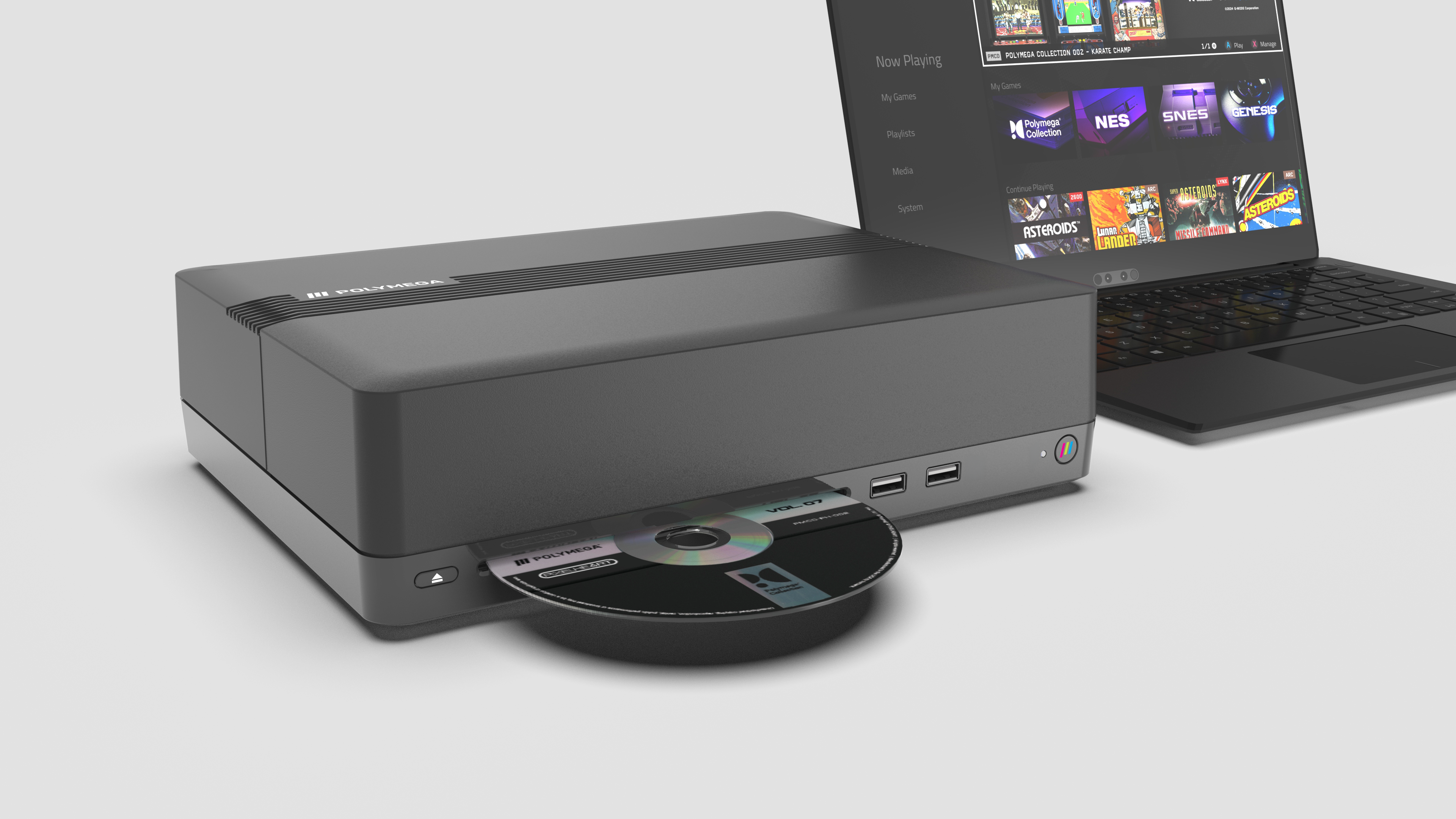
What ships in May. Polymega Remix is a $199 USB-C device that connects to a Windows 11 PC and reads physical retro-game media — CD-ROM, DVD-ROM, and the proprietary cartridge formats Polymega's earlier hardware already supported (PlayStation 1, Sega Saturn, Sega CD, TurboGrafx-CD, Neo Geo CD, plus cartridge modules for SNES, NES, Genesis, TurboGrafx-16, and others). It pairs with a Windows app that handles the disc-image creation and the play-back path. The Polymega name is not new — the company shipped a $499 standalone console in 2020 with a cult following. The Remix is the unbundle: take the disc-reading and the format-handling and the legal-compliance work, drop the bespoke chassis, sell it as a peripheral that plugs into a computer the buyer already owns. Two hundred dollars instead of five.
That price tag is the news. The retro-hardware aisle has had no consumer-shelf preservation device until now. The Neo Geo AES+ the field met three weeks ago is $399 and ships through specialty distributors. The Analogue Pocket is $220 and sells out in minutes during drops. The MiSTer FPGA ecosystem requires a kit, a case, and the willingness to flash cores. None of these get a slot on a Best Buy endcap. Polymega Remix is priced and packaged like a webcam: $199, USB-C, plug it in, the software walks you through it. The buyer profile widens from person willing to learn an emulator to person who can plug in a webcam. That is a categorical shift, not an incremental one.
"The retro hardware scene now has a four-tier authenticity taxonomy. Polymega Remix occupies the previously-empty consumer shelf."— Lumenforce
The taxonomy is the take. The retro-hardware field has spent four years arguing about authenticity in a way that assumes the question has a single answer. It does not. There are now four answers, and they coexist. Authentic silicon is the original board running on period CRTs — the enthusiast tier, scarcity-limited, expensive, and getting more so as supply ages out. FPGA-accurate is gateware that recreates the original silicon's behavior at hardware speed — the MiSTer + Analogue Pocket tier, mature, accurate, accessible to anyone willing to spend a weekend with it. ASIC-emulation is custom silicon plus permissive licensing that delivers the experience without the original chip — the Mini console line and now the Polymega Remix tier, plug-and-play, mainstream-shelf, no learning curve. Clean-room source is the decomp/recomp track that produces native PC ports of titles that never had one — the subject of today's companion dispatch, zero hardware, zero cost, scene-driven.
Three of those four tiers were here a year ago. The Polymega Remix is the tier that was missing. The argument the company is making, in product form: preservation can also be a Best Buy purchase. That argument has been made rhetorically for years; it has not been made by an actual product priced for that shelf. The Polymega Remix is the first one. The Neo Geo Mini and the Sega Genesis Mini are adjacent, but they are sealed-content nostalgia boxes — they ship with a fixed library and you cannot add to it. The Polymega Remix takes the disc you already own (or the disc the library has) and lets you play it. That is preservation-shaped. That is the part that makes it categorically different from the Mini line, even though it sits in the same ASIC-emulation tier.
The honest hedges. The Polymega track record is uneven. The 2020 console launched with significant manufacturing delays and a years-long dispute with backers over delivery timelines; the company is shipping Remix off a partial reputation, and "ships May 2026" should be read as a target. The "preservation" framing is partly marketing. Polymega Remix needs the user to own the original disc — it is a play-back device for media you already have, not a download service for media you do not. That is the legally-defensible posture and it is the right one, but it limits the device's reach to libraries with discs and consumers with disc collections. The device cannot save the 87% of pre-2010 games that exist only as data on already-degraded media in nobody's living room. The price will move. $199 at launch, almost certainly $179 or $169 by Black Friday, $149 by next May. Consumer hardware that ships at $199 in 2026 prices to $99 within three years. That trajectory is what makes this categorically different from the FPGA tier, where MiSTer kits have held their price for half a decade because the buyer pool is bounded.
What to watch. (1) Whether Best Buy or Target picks up the device for retail distribution within ninety days of launch. If yes, the consumer-shelf claim is real; if no, the device stays on the specialty-online tier and the taxonomy claim has to add a "specialty consumer" sub-tier. (2) Whether public libraries acquire the device for in-library disc-game playback under existing fair-use frameworks. The denied DMCA exemption closed the remote-access institutional path; in-library access is a different legal question and the Polymega Remix is the cheapest device that makes it operationally feasible. (3) Whether other ASIC-emulation companies follow the unbundle pattern — sell the smarts as a peripheral, not as a full console. If the move catches, the consumer-shelf tier fills out and the four-tier taxonomy stabilizes.
The one-line version. The retro-hardware field finally has a product that is priced, packaged, and named for the buyer who does not already know what an emulator is. The other three tiers keep doing their work; this tier just opened. The aisle is wider today than it was last week.