
Anbernic Just Built a Handheld With a Screen That Rotates Like a 2004 Motorola. The RG Rotate Is Weird. It's Also the Most Interesting Thing Anbernic Has Announced in Two Years.
The Anbernic RG Rotate ships with a 3.5-inch IPS display on a physical swivel hinge — landscape for 16:9 consoles, portrait for TATE-mode arcade games, and every angle in between. Pre-orders opened this week at $87.99. In a market that has spent the last eighteen months shipping functionally identical black rectangles with incrementally larger screens, the weirdest device in the Anbernic lineup is the only one that has a reason to exist beyond spec-sheet math.
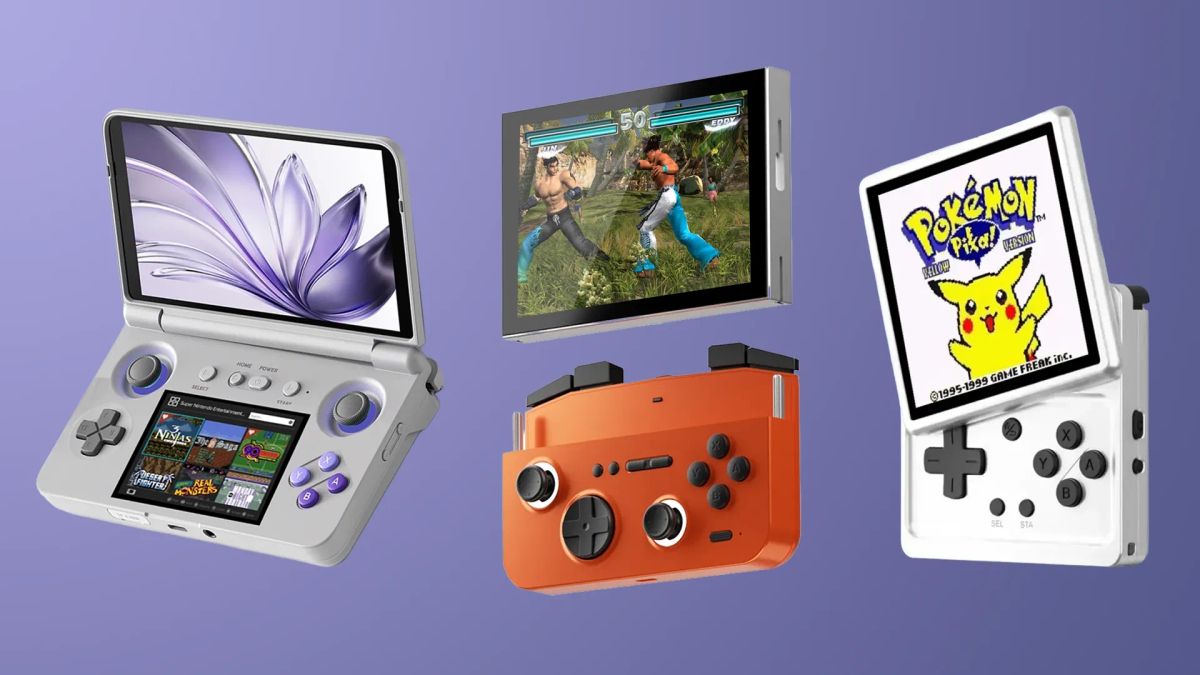
Here is the state of the retro-handheld market in the spring of 2026: a new device ships roughly every ten days, most of them are rectangles running Android on the same Unisoc T820 or Snapdragon 680, and the differentiator between a $90 handheld and a $110 handheld is usually a half-inch of screen diagonal and a marketing team's willingness to render the word "premium" in a different font. The category is not dying. It is calcifying. And into this market, Anbernic just dropped a device with a hinge.
The RG Rotate, per Retro Dodo's 2026 handheld preview coverage, places its 3.5-inch IPS display on a swivel mechanism that rotates the screen between landscape and portrait orientation. The body stays fixed — your hands don't move. The screen does. In landscape, the device presents a conventional 16:9 aspect ratio for PSP, DS, and home-console emulation. Rotate the screen to portrait and you get TATE mode: the vertical orientation that arcade cabinets used for shooters, puzzle games, and a whole generation of titles that have never been comfortable on horizontal handhelds. Per Retro Handhelds' weekly recap, pre-orders went live this week at $87.99.
That price matters. So does the timing. And the form factor matters more than either.
The TATE Problem Nobody Solved
Vertical arcade games have always been second-class citizens on handhelds. Ikaruga, DoDonPachi, Galaga, 1942, Strikers 1945, Espgaluda — the entire shmup canon was designed for a monitor taller than it is wide. Play any of them on a conventional landscape handheld and you get one of two bad options: the game is pillarboxed into a tiny vertical strip surrounded by black bars, or it's cropped and zoomed to fill the screen at the cost of the playfield you need to survive. Some emulators offer a software rotation option, but then the controls are wrong — your thumbs are oriented for landscape while the game is oriented for portrait. You can physically turn the entire device sideways, but now you're holding a handheld by its top and bottom edges, your thumbs are reaching across the short axis to find buttons, and the ergonomics range from uncomfortable to absurd.
The Rotate sidesteps all of that. The body — the grips, the d-pad, the face buttons, the shoulder triggers — stays put. The screen pivots above them. If the hinge mechanism is solid (the key engineering question no one can answer from a spec sheet), this means a player can shift from a horizontal PSP game to a vertical arcade shmup without any control-layout compromise. The hands don't need to adapt. The display does.
This is not a new idea in absolute terms. Tate-mode monitors have existed in arcade cabinets since the early 1980s. The Miyoo A30 attempted portrait-mode gaming in a small form factor. The GPD Win series offered screen-rotation software toggles. But a physical hinge that preserves the full control layout in both orientations, at under $90, on an Android device with access to the full emulator ecosystem? That is new at this price point.
Why This Is Interesting When the Rest of the Market Isn't
We wrote about RAMageddon killing boutique hardware earlier this year, and the core argument still holds: the retro-handheld market has a component-cost problem that is squeezing margins and homogenizing designs. When everyone is building from the same chip, the same RAM allocation, and the same panel supplier, the only remaining variable is industrial design — and most manufacturers are spending that budget on "thinner bezels" rather than "fundamentally different interaction model."
Anbernic's own recent catalog proves the point. The RG556, the RG406V, the RG353M — competent devices, all of them, and essentially interchangeable in the hand. Different screen sizes. Same emulation ceiling. Same software stack. Same experience. If you owned any Anbernic handheld from the last two years, purchasing the next one required an argument more convincing than "this one is slightly wider." Most buyers couldn't find that argument, because it didn't exist.
The RG Rotate is the first Anbernic device in recent memory where the argument is immediate and physical: this one does a thing the others cannot do. Not a spec bump. Not a screen-size increment. A mechanical capability that changes which games are comfortable to play. That's a different category of product differentiation, and it's the kind that this market desperately needs.
When the whole market is a spec sheet, the device with a hinge is the one with a thesis.
The Risks Are Obvious — and Worth Naming
A hinge is a moving part, and moving parts fail. The Motorola RAZR (the 2004 original, not the folding-screen revival) sold a hundred million units on the strength of its flip mechanism, but that mechanism also produced the most common failure mode in the phone's lifespan: ribbon cables wore out, hinges loosened, screens flickered. Anbernic is not Motorola. Anbernic's supply chain, quality-control processes, and price margins are not set up for precision mechanical engineering at scale. An $88 retail price does not leave room for the kind of hinge that survives 50,000 swivels without developing play.
Then there's Android. The RG Rotate runs Android, which means it inherits all of Android's TATE-mode complications: not every emulator handles screen rotation gracefully, auto-rotate settings can fight the user, and touch-input mapping in portrait orientation is historically flaky. RetroArch handles TATE well with the right config, but "with the right config" is doing a lot of heavy lifting for a device that's going to land in the hands of people who chose it precisely because they don't want to fight software to play Galaga the right way.
And 3.5 inches is small. In portrait, that's a screen roughly 2 inches wide and 3.1 inches tall — a playfield the size of a large postage stamp. For shmups with dense bullet patterns, that size might push the practical limits of visibility. The Rotate is not a device for players who want a cinematic experience; it's a device for players who want the correct experience on a small scale.
The Deeper Signal: Form Factor as Argument
The RG Rotate matters less as a product than as a signal. It's the first time in this market cycle that a major manufacturer has said, in effect: the constraint we're designing against is not the chip and not the screen — it's the shape. The category of games that deserve portrait orientation is large, well-loved, and chronically underserved by every handheld that treats landscape as the only layout. Anbernic is betting that a mechanical solution to a software problem will sell. If they're right, the implication for the wider market is that the spec-sheet arms race — more RAM, bigger screen, faster chip — has hit diminishing returns, and the next wave of meaningful differentiation has to come from industrial design.
We covered the AYANEO Pocket Block last cycle, and it's the same underlying thesis from a different angle: the most interesting new handhelds are the ones that have an opinion about what they're for, not just how fast they are. The Pocket Block's opinion is about size and price. The RG Rotate's opinion is about orientation. Both are more interesting than "we added Wi-Fi 6."
Whether the hinge holds up, whether Android cooperates, whether 3.5 inches is enough — those are real questions, and they're the kind of questions that can only be answered by the device in someone's hands, not by a spec sheet or a pre-order page. What's already clear from the announcement alone is that Anbernic, for the first time in two years, has shipped a thesis instead of an increment.
In a market that has been iterating without thinking, a weird device with a clear idea is worth more than a safe device with a bigger number.
The RG Rotate is available for pre-order at $87.99. If it ships and the hinge survives, it's the most interesting sub-$100 handheld of 2026. If the hinge doesn't survive, it'll be the most interesting cautionary tale. Either way: someone finally built a form factor that has something to say.