
Ryu on a 1-MHz Clock. RetroGL's Super Street Fighter II Turbo for the Commodore 64 Is Now Functionally Complete — and It's Better Than the Official 16-Bit Ports.
RetroGL has been building Super Street Fighter II Turbo inside the Commodore 64's 64 KB of RAM and 1 MHz clock for years. The May 2026 demo is functionally complete: all sixteen characters, Super moves, animation priority, and a custom engine called RetroFighter that treats the VIC-II chip like a tile-management co-processor. The result outperforms Capcom's own official ports to the Amiga, Mega Drive, and Master System — machines with four to eight times the resources. This is the best fighting game the Commodore 64 has ever run, and it is not close.
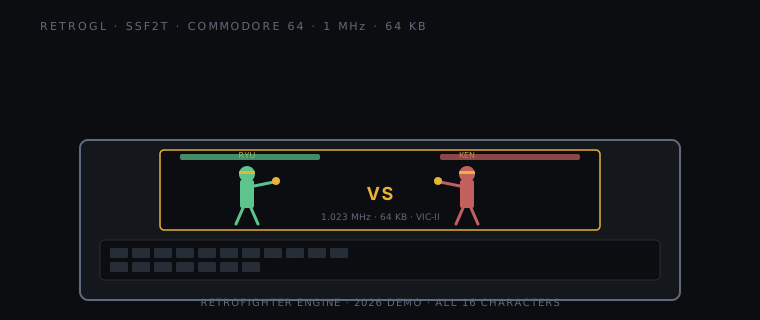
The Commodore 64 runs at 1.023 MHz. Its MOS 6510 CPU addresses 64 KB of RAM. Its VIC-II graphics chip can display 320×200 pixels in hi-res mode, or 160×200 in multicolor, and it has eight hardware sprites — each 24×21 pixels, each single-color unless doubled. The machine shipped in August 1982. Super Street Fighter II Turbo shipped in arcades in February 1994, running on a CPS-2 board with a 16 MHz 68000 CPU, 1.17 MB of work RAM, and a dedicated sprite engine that could move hundreds of objects per frame. The gap between those two machines is not a gap. It is a geological fault line.
RetroGL has been building a bridge across that fault line for years, and per the primary development thread on Lemon64, the May 2026 build is functionally complete. All sixteen playable characters. Super combos. Throws. Dizzies. Animation priority that mirrors the CPS-2 original's hit/hurt box relationships. A training mode. A character-select screen with proper portraits. The project has gone from proof-of-concept curiosity to a port that raises a genuinely uncomfortable question: how does an 8-bit hobbyist port outperform official 16-bit commercial releases from the 1990s?
The RetroFighter Engine
The answer is the engine. RetroGL built a custom framework called RetroFighter specifically for fighting games on the C64. Per the Lemon64 forum posts from May 15, 2026, the engine treats the VIC-II not as a bitmap canvas to be brute-forced but as a tile-management co-processor. Character sprites are assembled from combinations of character-mode tiles and hardware sprites, swapped per-frame in a raster-timed pipeline that exploits the VIC-II's open bus cycles. The technique is not new — the best C64 demos have been multiplexing sprites since the late 1980s — but applying it to a fighting game's animation system, where every character has dozens of unique frames across multiple states (idle, walk, jump, attack, hit, dizzy, win pose), is an engineering problem of a different order.
Per the Pants Pants Revolution coverage, the engine handles sixteen distinct character movesets. That's not sixteen palette-swaps sharing a skeleton — it's sixteen individual sprite sheets, hit box tables, and animation state machines, all fitting inside a machine that ships with less memory than a single uncompressed CPS-2 sprite tile.
RetroGL's solution is aggressive compression and streaming. Character data loads from disk per match; only the two active fighters and the stage background occupy RAM simultaneously. The background itself uses the VIC-II's character mode rather than bitmap mode, which saves memory at the cost of tile-grid constraints — constraints that RetroGL has turned into a style. The stages look like Street Fighter interpreted for the C64's palette and resolution rather than downscaled from the arcade. That interpretation is the right call. Every bad retro port in history has been bad because it tried to shrink the source; every good one has been good because it re-imagined the source for the target hardware's strengths.
Better Than the Official 16-Bit Ports — and Here's Why That Claim Holds
The headline claim needs defending. Capcom officially ported Super Street Fighter II (not Turbo, notably — the Super combos were absent) to the Mega Drive in 1994 and the Amiga in 1996. The Mega Drive port ran on a 7.67 MHz 68000 with 64 KB of work RAM and a dedicated VDP that could push 80 sprites per scanline. The Amiga port ran on machines with at least a 14 MHz 68020 and the AGA chipset. Both platforms had at minimum an order-of-magnitude CPU speed advantage over the C64, dedicated blitter hardware, and wider color palettes.
And both official ports are compromised. The Mega Drive version shipped with reduced animation frames, truncated stages, missing voice samples, and a character roster that excluded the four New Challengers in some regions' marketing but included them in-game at the cost of cartridge space that could have preserved animation fidelity. The Amiga version — the Oasis BBS post notes this context clearly — was widely regarded as one of the worst official Capcom ports of the era, with jerky scrolling, input lag, and artwork that looked like it had been resized in Deluxe Paint without regard for the pixel grid.
RetroGL's C64 port, per the Indie Retro News coverage of the May 12, 2026 update, matches the Mega Drive port's character count, exceeds it by including Super combos (which the MD version lacked), and — critically — maintains consistent frame pacing. The animation is reduced, yes. The sprites are smaller, yes. But the feel — the input response, the hit-stop timing, the way a Shoryuken's invincibility frames line up with the visual cue — tracks the CPS-2 original's design intent. RetroGL has reportedly studied the arcade version's frame data and replicated the timing relationships even where the visual fidelity cannot follow.
"Sixteen characters. Super combos. Throws. Dizzies. On a machine that shipped with less RAM than a single uncompressed CPS-2 sprite tile."
This is the distinction that separates a port from a de-make. A de-make reproduces the look. A port reproduces the behavior. RetroGL has built a port.
What the Demo Shows — and What It Doesn't
Per the Lemon64 thread's May 15 posts, the current demo build includes the full sixteen-character roster, a working character-select screen, multiple stages, Super combo inputs, and basic AI. What it does not yet include, per RetroGL's own posts: a complete single-player arcade ladder, all stage backgrounds (some are placeholder or in-progress), final audio mixing for all music tracks, and netplay (which, on a C64, would require a custom solution — the Overserved WiFi cartridge project suggests the scene is thinking about this class of problem, but that's Neo Geo territory, not C64).
The audio deserves its own note. The C64's SID chip is one of the most celebrated sound chips in computing history, and RetroGL appears to be using it well — the forum thread includes references to SID renditions of character themes that take advantage of the chip's analog filter rather than trying to reproduce FM synthesis patches from the CPS-2's QSound chip. Again: interpretation, not downscaling. The right instinct.
Who Made This
RetroGL is the handle. The developer has been active on Lemon64's forums for the duration of the project, posting work-in-progress builds, responding to feedback, and documenting the RetroFighter engine's development in public. The engine is purpose-built — it is not a general-purpose C64 game framework but a fighting-game-specific toolkit that handles sprite multiplexing, animation state machines, hit box collision, and disk streaming for the specific demands of a one-on-one fighting game.
The work is solo, as far as the public thread indicates. One developer. One engine. One port. On hardware that turned forty-three years old last August.
This is the pattern that Lumenforce Lab exists to document. The scene's most ambitious work is almost always solo or near-solo. It is almost always under-covered by the outlets that cover the platforms these projects target. And it is almost always technically more interesting than the commercial releases that get the column inches. Johnny Acevedo's Moon Cresta port for the Amiga was the same shape — one developer, one machine, one game, a result that outperformed expectations by reframing what the hardware could do. RetroGL's SSF2T is that, at a scale that makes the Moon Cresta port look like a warm-up exercise.
The Broader Context: C64 Homebrew in 2026
The Commodore 64 homebrew scene has been on a sustained run. Commodore's C64C Ultimate shipped original-mold cases for new builders. Clamshell handhelds running C64 cores put the platform in pockets. And the software side has kept pace — new puzzle games, platformers, shoot-'em-ups, and RPGs have been shipping on cartridge and disk for a machine whose commercial life ended in 1994.
But a fighting game is different. Fighting games are the hardest genre to port because they are the least forgiving of compromise. A platformer can drop frames and still be playable. A puzzle game can run at 30fps and nobody notices. A fighting game lives and dies on input latency, frame advantage, and animation readability. If a Hadouken's startup is three frames on CPS-2 and five frames on C64 because the engine can't keep up, the move is functionally different — it's slower, safer on block, less useful as a punish. The game stops being Super Street Fighter II Turbo and becomes something else.
RetroGL's achievement is that the game, per every source available, still plays like SSF2T. The frame data tracks. The spacing matters. The Super meter builds at the right rate. The engine does not just display the game — it simulates it, within constraints that would make most developers walk away before writing a single line of 6502 assembly.
What's Next
Per the Lemon64 thread, RetroGL is working toward a complete release — full arcade mode, all stages finalized, polished audio, and potentially a physical cartridge release. The RetroFighter engine itself may have a life beyond SSF2T; a fighting-game engine for the C64 is a tool that other developers could use, and the C64 scene has historically been good about sharing frameworks. Whether RetroGL plans to release the engine separately is not yet clear from the public posts.
The demo build is available now through the channels documented in the Lemon64 thread. It runs on real hardware and in emulation (VICE being the standard). The recommendation from this corner: try it on real hardware if you have it, or on a cycle-accurate emulator if you don't. The SID audio and the VIC-II's color bleed are part of the experience. An emulator running in fast-forward mode will not convey what this project actually does — which is make a 1 MHz machine feel like it has no business running this game, and then run it anyway.
Ryu on a 1 MHz clock. It shouldn't work. It does. RetroGL built the engine that makes it work, and the engine is the story.