
Pocket-Sized 1986: The C64 and ZX Spectrum Get the Clamshell Treatment
Blaze Entertainment and Retro Games Ltd. announced THEC64 Handheld and The Spectrum Handheld — two clamshell portables launching October 2026 that reimagine the Commodore 64 and ZX Spectrum as Nintendo-style foldable devices. Both ship with 25 built-in games, a 4.3″ 800×480 IPS screen, MicroSD slot for sideloading, and USB-A for external keyboard or joystick — at £109.99 / $129.99 / €129.99, pre-orders open now. The pitch, verbatim: "What if your favourite home computers of the 1980s were portable?" Good question. The answer is a GBA SP shell with forty years of platform identity folded inside it.
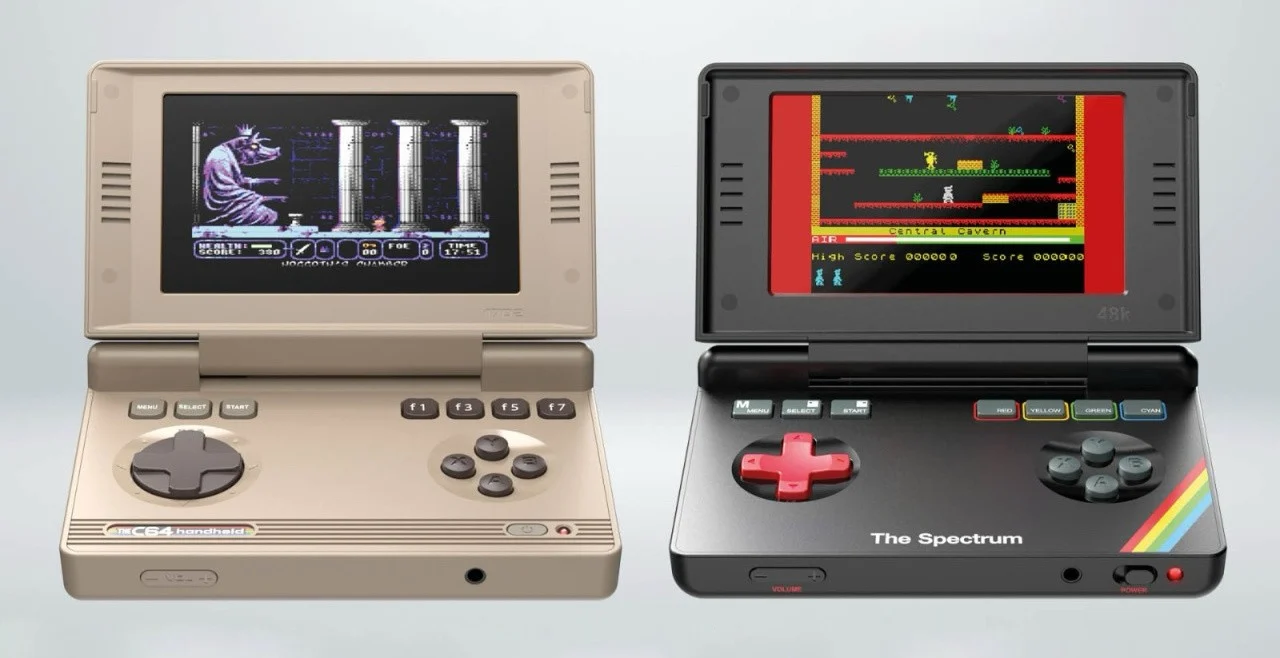
There is a particular species of consumer electronics announcement that arrives like a letter from someone you thought had moved away. You open it, read the specs, and immediately feel ridiculous for how much you care. THEC64 Handheld and The Spectrum Handheld are that letter. They are not technical marvels. They are not FPGA. They are software-emulated home computers folded into a clamshell form factor that borrows openly from the Game Boy Advance SP, and they cost more than twice what a budget Chinese emulation handheld costs. And none of that matters, because the bet Blaze is making isn't about silicon. It's about identity.
The Spec Sheet, Honestly
Let's get the hardware out of the way before the sentimentality takes over. Both units share a common chassis: 4.3-inch 800×480 IPS display, MicroSD slot, USB-A port for peripherals, rechargeable battery, clamshell hinge. Twenty-five games pre-loaded on each. Pre-orders are live at £109.99 / $129.99 / €129.99, with an October 2026 street date.
Where they diverge is in the emulation breadth. THEC64 Handheld switches between C64 PAL, C64 NTSC, C64C, C64SX, PET64, and C64 GS configurations. That's not a dropdown menu — that's a declaration. The Spectrum Handheld covers Spectrum 48K through +3e and 16K variants, with CPU under- and overclocking. Both devices accept full game files via MicroSD — not just the curated 25 — and the USB-A port means you can plug in a real keyboard and pretend the living room is 1984 again, except the living room is now Gate B27 at Heathrow.
This is emulation, not FPGA. No gate-level accuracy claims. No cycle-exact guarantees. For the premium tier — the Analogue Pocket crowd, the MiSTer faithful — that distinction is load-bearing. For the audience Blaze is actually chasing, it is inaudible.
"What if your favourite home computers of the 1980s were portable?" — a question that sounds like marketing copy until you realise nobody had actually answered it.
The Anbernic Problem (and Why It Isn't One)
The obvious objection: an Anbernic RG28XX costs roughly $48 and runs RetroArch with cores for the C64, the Spectrum, and fifty other platforms. You can have the same games, the same screen proportions, and change to the next handheld form factor whenever the next Shenzhen factory ships one. For $82 less.
This is true and irrelevant. The RG28XX is a Swiss Army knife. THEC64 Handheld is a bread knife your grandmother owned. It does one thing. The thing has a name. The name is on the lid.
Blaze appears to understand this. The Collector's Editions — limited to 2,000 units each — bundle a hard case and an exclusive magazine: Crash with the Spectrum, Zzap with the C64. This is not a spec upgrade. It is an artifact. The magazine doesn't make the emulation run faster. It makes the purchase feel like a ritual. And in the nostalgia-hardware market, ritual is the product. The device is just the receipt.
Form Factor as Argument
The clamshell is doing real work here. The Commodore 64 was a desktop slab that weighed four pounds and needed a television and a datasette. The ZX Spectrum was a rubber-keyed brick that overheated on the carpet. Neither machine was portable in any meaningful sense. Cramming them into a GBA SP shell isn't miniaturisation — it's translation. The form factor says: these were always about personal computing, even before personal computing fit in a pocket.
And the format toggles are the proof of seriousness. If you're selling nostalgia alone, you ship one configuration and call it a day. If you're shipping six C64 variants and seven Spectrum models, you are courting people who know the difference between a 48K and a 128K+2A — and who have opinions about it. CPU clock control on the Spectrum side is a quiet flex: it tells the accuracy-conscious buyer that Blaze at least acknowledges the argument, even if the underlying emulation is software, not silicon.
Where Blaze Sits on the Shelf
The hardware-revival market has stratified into three shelves in the past two years, and Blaze is deliberately choosing the middle one.
The premium shelf belongs to FPGA: Analogue's Pocket and the forthcoming AES+ from Plaion Replai/SNK. Gate-level accuracy, original cartridge support, price tags that start at $220 and climb. This shelf courts the collector who frames the box.
The budget shelf is Anbernic, Miyoo, Powkiddy — Shenzhen generics running RetroArch behind a hundred-dollar ceiling. These devices are excellent and disposable. They have no brand loyalty because they have no brand.
The middle shelf — where Blaze lives alongside its own Evercade line — sells identity. A specific platform name. A specific aesthetic. A specific bundle of curated games that someone picked on purpose. The price reflects the curation, not the chip. This is the shelf where the buyer already owns a RetroArch handheld and still reaches for the branded one because it means something different to hold a device that says COMMODORE on it.
Is $130 the right price for meaning? That's not a hardware question. It's a question about what you're willing to pay for a machine that is, on some level, a portrait of yourself at twelve years old. Blaze is betting that number is higher than $48. I suspect they're right.
The Sideloading Clause
Both units accept game files via MicroSD. This is the detail that transforms the devices from curated-nostalgia-boxes into platforms. Twenty-five built-in games is a starter kit. The full C64 and Spectrum libraries — legally available through abandonware archives, homebrew scenes, and the user's own disk images — number in the tens of thousands. A clamshell with MicroSD sideloading is, functionally, a dedicated platform emulator that happens to ship with a sample platter.
The USB-A port extends the argument further. Plug in a keyboard and THEC64 Handheld isn't just playing games — it's running BASIC. The Commodore 64 and the ZX Spectrum were programmable computers, not consoles. Preserving that programmability — even in a folding shell with a 4.3-inch screen — is the difference between a toy and a tool. Blaze seems to understand which side of that line matters.
The form factor says: these were always about personal computing, even before personal computing fit in a pocket.
October Is a Long Way Off
Pre-orders are open. Shipping is five months away. A lot can go wrong between now and October — emulation accuracy might disappoint, the hinge might feel cheap, the 25 bundled games might lean on the forgettable half of each library. Blaze's track record with Evercade is solid but not flawless; the Evercade EXP had launch firmware issues that took months to patch.
But the announcement itself is worth marking. Not because these devices will replace anyone's MiSTer or Analogue Pocket. They won't. Because they articulate a position the hardware-revival market needs: not every preservation device has to be the most accurate one. Some of them just have to be the right shape, with the right name, at the right price, in your coat pocket when the flight is delayed.
A Commodore 64 that fits in your hand. A ZX Spectrum that folds shut. Forty years late, and exactly on time.
If you grew up typing LOAD "" or POKE 53280,0 — which 25 games would you put on the built-in list? We're keeping a running tally. Drop your picks in the comments or send them to the usual channels.