
Four Founders. One Room. The First Time Since 1993. QuakeCon 30 Is About to Become the Most Important Night in Shooter History.
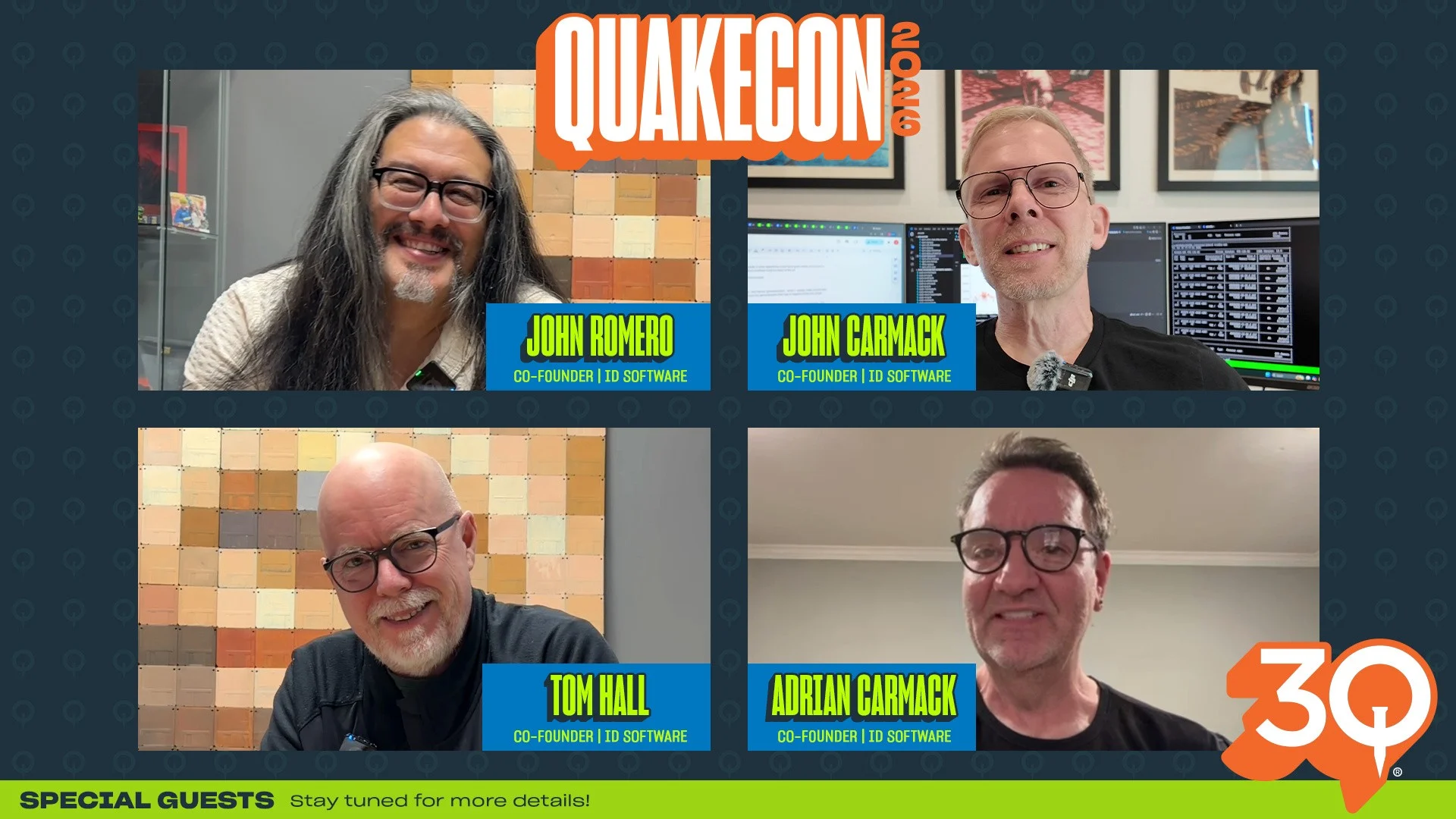
John Carmack. John Romero. Tom Hall. Adrian Carmack. They haven't shared a room since the company they built together was still small enough to fit in a lake house. QuakeCon 2026 — the event's thirtieth anniversary — will reunite all four co-founders of id Software on stage for the first time in over three decades. The studio turns thirty-five the same year. The genre they detonated into existence turns older than most of the people who play it. And for one night in August, the entire primary-source record of how the first-person shooter was born will be sitting in the same row of chairs.
The photograph is black-and-white and badly scanned. It lives on fan sites and in the appendices of oral histories, and it shows four young men in a cramped office at the Town East Tower in Mesquite, Texas, sometime in late 1991 or early 1992. The desks are pushed together. There are monitors everywhere. One of the men — John Carmack, twenty-one years old — is looking at code. Another — John Romero, twenty-four — is looking at a level. Tom Hall is gesturing at something off-camera. Adrian Carmack, no relation to John, is drawing. They are building Commander Keen. Within eighteen months, they will ship Wolfenstein 3D. Within thirty, Doom. The four of them together, in the same room, making the same thing — that arrangement lasted roughly two years. Then it ended, and it stayed ended for thirty-two more.
Per Time Extension's reporting, QuakeCon 2026 will be the first time all four co-founders of id Software have been together since 1993. The event takes place in August in Grapevine, Texas — the same DFW orbit where id built the shooter from nothing. It is QuakeCon's thirtieth anniversary. It is id Software's thirty-fifth. The convergence is not accidental, and its implications for the historical record are significant.
The Lake House and the Fault Lines
id Software was founded on February 1, 1991, by four people: John Carmack (engine), John Romero (tools and design), Tom Hall (creative director and designer), and Adrian Carmack (art). They had been making games together at Softdisk Publishing in Shreveport, Louisiana, moonlighting on a side-scrolling demo that proved the PC could do smooth horizontal scrolling — the trick that became Commander Keen. When Apogee's Scott Miller offered them a distribution deal, they quit their day jobs and moved to a house near a lake. The company was, in every meaningful sense, four people in a room.
What happened next is one of the most documented studio histories in the medium. David Kushner's Masters of Doom (2003) remains the standard popular account. Romero's own Doom Guy: Life in First Person (2023) provides his side. Carmack's public talks, particularly his keynotes at QuakeCon from 1996 onward, constitute a parallel technical history. Between the three sources, the founding period is well-covered — but almost entirely from the perspective of two of the four founders.
Tom Hall left id Software in August 1993, during the development of Doom. The departure was not amicable. Hall's design document for the game — the famous "Doom Bible" — had been progressively overruled by Carmack and Romero's preference for speed over narrative. Hall went to Apogee (later 3D Realms), where he co-designed Rise of the Triad and contributed to Duke Nukem 3D. His public comments about the id years have been measured, gracious, and infrequent.
Adrian Carmack's departure came later — he was pushed out of id Software in 2005, a decade after the company had already transformed into something unrecognizable from the lake house. Adrian sued. The case settled. He has given almost no public interviews since. His art — the visceral, meaty, horror-influenced aesthetic that defined Doom's visual identity — is one of the most influential bodies of game art ever produced, and the artist behind it has been functionally absent from the public record for two decades.
Romero left id in 1996, after Quake shipped. The split with John Carmack was the industry's most famous professional divorce: the designer who wanted spectacle and the programmer who wanted purity, unable to occupy the same vision. Romero founded Ion Storm, shipped Daikatana, weathered the reception, and spent the next twenty years rebuilding a career on his own terms. Carmack stayed at id through the Bethesda acquisition, left for Oculus in 2013, and has since become a public technologist whose talks on AI, aerospace, and game engines draw audiences that dwarf QuakeCon's.
Four people. Four different trajectories after the room emptied. And now, per Blue's News, all four have confirmed attendance at the same event for the first time since Bill Clinton's first year in office.
What Was Built in That Room
The temptation is to list the games: Commander Keen (1990–91), Wolfenstein 3D (1992), Doom (1993), Quake (1996). But the games are the surface. What id built in that two-year window — the period when all four founders were actively collaborating — was a set of structural assumptions that still govern how shooters work.
Carmack's engines introduced the idea that rendering technology was itself a creative medium. The id Tech lineage — from the Wolfenstein raycaster through the Doom engine's binary space partitioning to Quake's true 3D — wasn't just a series of technical improvements. Each engine redefined what a level designer could build, which redefined what a game could be. The engine was the argument.
Romero's level design, particularly in Doom, established the grammar of spatial storytelling in shooters: the locked door, the key hunt, the arena reveal, the ambush trigger. These weren't Romero's inventions from scratch — Ultima Underworld had explored 3D spaces before Doom shipped — but Romero's implementation was so fast, so legible, and so replayable that it became the default. Every corridor shooter released in the next decade was, in some sense, a response to E1M1.
Hall's contribution is the hardest to see, precisely because his largest design document was rejected. The Doom Bible proposed a narrative-driven, character-heavy structure for what became the medium's purest action game. Hall lost that argument. But the arguments he was making — that shooters could sustain characters, that levels should have thematic coherence, that worldbuilding was not antithetical to speed — resurfaced everywhere in the decade that followed. Half-Life. System Shock 2. Halo. The immersive sim and the narrative shooter are, in a real sense, what happens when someone takes the Doom Bible seriously in a context where the engine can support it.
Adrian Carmack's art is the one that registers immediately and gets credited last. The imp. The Cyberdemon. The shotgun. The texture work that made Doom's Hell feel like meat and rust rather than a Dungeons & Dragons tileset. Adrian's visual language defined an entire register of game aesthetics — the "visceral" mode that every horror-action game from Quake to Dead Space to Doom 2016 draws from. Hugo Martin and the modern id art team have spoken openly about Adrian's influence. The influence is everywhere. The artist is not.
Why the Room Matters Now
The reunion is not a panel. It is — or could be — a primary source event.
"The entire primary-source record of how the first-person shooter was born will be sitting in the same row of chairs."
Game history has a preservation problem that isn't just about binaries and ROMs. It's about testimony. The people who built the foundational works of the medium are aging out of public life, and their accounts — when they exist at all — are scattered across podcasts, convention panels, out-of-print books, and social media posts that are one platform migration away from disappearing. We've watched twenty-four years of forum history vanish overnight because someone cancelled a hosting plan. Oral history is even more fragile.
The id Software founding story is better documented than most. Kushner's book exists. Romero's memoir exists. Carmack's keynotes are archived. But the four-person version of the story — the one where all perspectives are present, where Hall can respond to Carmack's account of the Doom Bible dispute, where Adrian can describe his own departure in his own words, where Romero and Carmack can sit with their disagreements in the same physical space — that version has never been recorded. It has never been possible to record, because the four of them have not been together.
QuakeCon has the infrastructure. Bethesda, which owns id Software and operates the event, has the resources. The event's official page has already signaled the reunion as a marquee moment. The question is whether anyone treats it as what it actually is: the last best chance to get the complete oral history of the most consequential studio in shooter history, from all four of the people who were in the room.
The Preservation Stakes
id Software's technical legacy is, paradoxically, both the best-preserved and the most at-risk body of work in the medium.
Best-preserved because Carmack open-sourced the engines. The Doom source code has been public since 1997. The Quake source followed in 1999. This act — radical at the time, still unusual now — created a preservation floor that almost no other studio's work has. You can compile id Tech 1 today. You can read the BSP traversal. The code is the artifact, and the artifact is accessible.
At-risk because the assets, the design documents, the internal communications, and the cultural context are not similarly protected. The Doom Bible circulates online, but its provenance is fan-maintained. Adrian Carmack's original art — the pen-and-ink drawings, the clay models he sculpted for texture reference, the sketches that became the bestiary — exists in private hands, if it exists at all. The company's internal correspondence from the 1991–1996 period is not archived in any institutional collection. The institutional frameworks for game preservation are themselves under siege. If Adrian's art is in a box in a garage somewhere, there is no mechanism that compels its preservation and no institution with a clear mandate to receive it.
Tom Hall's design documents from the period — not just the Doom Bible, but the Commander Keen design notes, the internal proposals for projects that didn't ship, the creative-director memos — are similarly unarchived. Hall has been generous with fans over the years, sharing fragments on social media and at conventions. But fragments on social media are not an archive. They are a scattering.
Romero has been the most active preservationist among the four, maintaining a public presence, giving interviews, and publishing his memoir. Carmack's record is preserved through the sheer volume of his public technical output — decades of keynotes, tweets (now X posts), and long-form writing. But neither man's archive is institutional. Both are personal, which means both are one hard-drive failure or estate decision away from partial loss.
Thirty Years of QuakeCon
QuakeCon itself is a preservation story. The first event was held in 1996, organized by fans, not by id. It was a LAN party in a hotel in Garland, Texas. Carmack showed up. The event grew. By the early 2000s, it was the largest LAN party in North America. Carmack's annual keynotes — three-hour, unscripted technical lectures delivered without slides — became legendary, not because they were polished, but because they were primary sources. A programmer explaining, in real time, what he was building and why. The keynotes are archived on YouTube, patchily. Some are complete. Some are fragments. The audio quality varies. No institution has taken responsibility for the full run.
Bethesda took over QuakeCon's operations after acquiring id in 2009. The event has continued annually, with pandemic-era interruptions, but its character has shifted from grassroots LAN gathering to corporate convention. The thirtieth anniversary presents an opportunity to thread both identities — the community event that grew up around a studio, and the corporate showcase that sustains it. The reunion of the four founders is the thread.
Per Bethesda's Slayers Club announcement, 2026 marks id Software's thirty-fifth anniversary, and the company has signaled celebrations throughout the year. The QuakeCon reunion sits at the center of that calendar. Whether Bethesda treats the occasion as a marketing beat or as a preservation event will say something about what kind of steward it intends to be for the legacy it purchased.
What Happens in August
There is a version of this reunion that is a photo op: four men on stage, a moderator asking soft questions, an audience cheering, a highlight reel. That version is fine. It is also insufficient.
There is another version — the one preservation demands — where someone puts a proper recording setup in front of all four founders and lets the conversation run long. Not a panel. An oral history session. Structured enough to cover the key decision points (the move from Softdisk, the Wolfenstein pivot, the Doom Bible dispute, Adrian's art process, the Quake crunch, the departures) and unstructured enough to let the four of them talk to each other, not to an audience. The Time Extension report describes the reunion as a confirmed appearance, not a structured interview. The format is still open.
"The code is the artifact, and the artifact is accessible. The rest — the art, the documents, the testimony — is not."
Organizations like the Video Game History Foundation have spent years arguing that game preservation extends beyond playable software to encompass the full material and testimonial record of how games were made. The id Software founding period is a case study in what that argument means in practice. The engines survive because Carmack released them. The games survive because they sold millions of copies. But the creative process — the arguments, the sketches, the rejected designs, the human friction that shaped every decision — survives only in the memories of four people who haven't been in the same room since before the internet was a consumer technology.
August is coming. The room is booked. The four founders have said yes. What remains is for someone — Bethesda, a historian, an archival organization, or the founders themselves — to recognize that a reunion is not just an event. It is a window. And windows, in this medium's short and careless history, do not stay open long.
If you've attended a QuakeCon — especially the early LAN-party years — and have photos, recordings, or memories worth preserving, the historical record needs them. Community-sourced archives are how the grassroots half of this story survives.