
Every N64 Recomp Port. One Shelf. The N64RecompLauncher Quietly Became the Best Reason to Finally Try These Ports.
The N64Recomp toolchain has already spawned native PC ports of over a dozen Nintendo 64 games — Zelda 64: Recompiled, the project that started it all, plus Bomberman Hero, Perfect Dark, Rocket: Robot on Wheels, and more. But each port is its own executable, its own settings menu, its own folder on a drive somewhere. N64RecompLauncher by retrofan2019 solves exactly the problem you'd expect: it puts every recomp port on one shelf, with one launch point, and it just shipped v1.2.0. This is the front-end the recomp wave was missing.
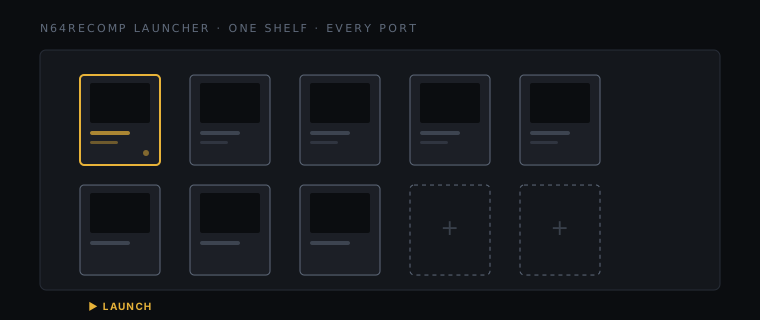
The experiment: one launcher, every recomp port
The premise is simple: N64Recomp, the static-recompilation toolchain created by Wiseguy (Mr-Wiseguy on GitHub), takes a Nintendo 64 ROM and outputs a native PC executable. No emulator in the loop. No interpreter. The MIPS instructions get transformed into C code, compiled natively, linked against a runtime that handles the N64's rendering pipeline through RT64. The result runs on modern hardware at arbitrary resolutions with ray-traced lighting if you want it. We've covered the recomp-versus-decomp argument before — the short version is that recomps trade source-level flexibility for speed-to-ship, and that tradeoff is winning.
The problem is what happens after you collect more than three of these ports. Each recomp project — Zelda 64: Recompiled, Bomberman Hero Recompiled, Perfect Dark Recompiled, Dr. Mario 64, Rocket: Robot on Wheels, and the growing list beyond — is its own standalone binary. Its own window. Its own settings. Its own folder on your drive. There is no shelf. There is no library view. You end up doing what PC gamers have done since the 1990s: you make a folder called "N64 Recomps" and drop shortcuts in it. It works. It is also aesthetically bankrupt.
N64RecompLauncher, by a developer named retrofan2019, is the answer to the shelf problem. Point it at your recomp executables. It scans, catalogs, presents a grid. Click a title, it launches. Close the game, you're back on the shelf. That's it. That is the entire promise. And it is exactly what this ecosystem needed.
What N64RecompLauncher v1.2.0 ships with
Per the v1.2.0 release notes, the launcher now supports:
- Auto-detection of recomp executables. Point it at a root folder; it walks the tree and finds every recomp binary it recognizes.
- Custom box art and metadata. The launcher pulls cover images and game titles from a bundled database. Users can override with their own art — a nice concession to the collector's impulse to make the shelf look right.
- Per-game launch arguments. Some recomp ports accept command-line flags for resolution, RT64 settings, or mod paths. The launcher stores these per-title so you set them once.
- Automatic update checking for known recomp repos. The launcher can flag when a new release is available upstream, though it doesn't auto-install — a reasonable safety boundary.
- Gamepad-navigable UI. The grid is designed to be used from a couch with a controller. This is the detail that signals intent: retrofan2019 is building a living-room front-end, not a developer utility.
The application is Windows-only for now, written in C# with a Avalonia UI layer. Per the repo's issue tracker, Linux support is in progress — Avalonia is cross-platform by design, so the port path is real, not aspirational.
Why the shelf matters
This is a familiar pattern in emulation: the core technology ships, then the ecosystem grows around it, and the front-end arrives last. RetroArch was, among other things, the answer to the question "what do I do with forty standalone emulators?" Pegasus, Playnite, EmulationStation — every generation of emulation reaches the point where someone builds the library view, and the library view is what makes the technology legible to people who aren't already deep in the scene.
N64Recomp is at exactly that inflection point. The toolchain works. The ports are shipping. Zelda 64: Recompiled has been covered by Eurogamer, PC Gamer, and a hundred YouTube channels. But the moment someone has Zelda, Perfect Dark, Bomberman Hero, and Rocket: Robot on Wheels all recompiled and sitting in separate folders, the question becomes: "Where is the front door?" N64RecompLauncher is the front door.
"The front-end is what makes the technology legible to people who aren't already deep in the scene. N64RecompLauncher is the front door to the recomp era."
The tool-maker stack
Credit where credit builds the house:
Wiseguy (Mr-Wiseguy on GitHub) built N64Recomp and Zelda 64: Recompiled. The static recompilation approach — taking MIPS binaries and outputting compilable C — is not new in concept (it's how some commercial N64-to-GameCube ports were built internally), but Wiseguy's toolchain is the first to make it publicly available, repeatable, and open. Every port on the launcher's shelf exists because this tool exists. The N64Recomp repo is MIT-licensed.
RT64 (GitHub), the rendering backend that recomp ports use, is maintained by DarioSamo and others. RT64 handles the N64's RDP (Reality Display Processor) operations through a modern rendering pipeline with optional ray tracing. It is, functionally, a rendering engine purpose-built to make N64 graphics run natively on DirectX 12 and Vulkan hardware. Without RT64, the recomp ports would produce executables that do everything except draw to the screen.
retrofan2019 (GitHub) built N64RecompLauncher. The project is young — first release was in early 2026 — but the v1.2.0 feature set shows someone who understands what the front-end needs to do and, critically, what it needs to not do. It launches. It organizes. It doesn't try to become a modding platform or a social network.
The individual port authors deserve the same credit: Francessco121 for Bomberman Hero Recompiled, Malkierian for Rocket: Robot on Wheels, AngheloAlf for Dr. Mario 64, and the growing roster of developers picking N64 titles off the shelf and running them through Wiseguy's toolchain. Each port is its own project with its own quirks, its own compatibility notes, its own issue tracker. The launcher gives them all a common address.
What this means for the recomp wave
The recomp movement has a structural advantage over decomps: speed. A decompilation project — Twilight Princess's took five years — requires reverse-engineering the entire source, function by function, until you have compilable C or C++ that produces a byte-identical binary. A recomp takes the existing binary and transforms it mechanically. The tradeoff is flexibility: decomps give you the source and everything that comes with it (modding, porting to other platforms, deep optimization), while recomps give you a working native binary fast, but the binary is less malleable.
That tradeoff means recomps generate volume. There are already more N64 recomp ports than there are N64 decomps, and the gap will only widen. Volume creates the library problem. The library problem creates the need for a front-end. The front-end creates the perception of a platform. And the perception of a platform is what pulls people in from the edges — the people who heard about Zelda 64: Recompiled but haven't tried it yet, the people who didn't know Bomberman Hero got the same treatment, the people who want to play Perfect Dark at 4K but don't want to navigate GitHub release pages to do it.
The recomp wave is already reaching the Xbox 360 through separate toolchains like XenonRecomp. If that pipeline hits the same volume inflection, it will need its own front-end. N64RecompLauncher is the template.
The games on the shelf right now
Per the launcher's supported-games list and the broader n64recomp topic on GitHub, the current roster includes:
- Zelda 64: Recompiled — Ocarina of Time and Majora's Mask in one package. The flagship. Ray-traced lighting, widescreen, high-resolution UI. This is the project that proved the concept.
- Bomberman Hero Recompiled — Hudson Soft's 1998 platformer, now running natively. A game that was always better than its reputation suggested.
- Perfect Dark Recompiled — Rare's shooter masterpiece, with the framerate it always deserved and never got on original hardware.
- Rocket: Robot on Wheels — Sucker Punch's first game, a physics platformer from 1999 that was ahead of every curve except the commercial one.
- Dr. Mario 64 — the late-era N64 puzzle game that shipped when everyone had already moved on to the GameCube announcement. Now playable without the stigma of showing up to a dead console's wake.
- Dinosaur Planet — the unreleased Rare game that became Star Fox Adventures after Nintendo intervened. The leaked ROM, recompiled, running natively. A preservation artifact turned playable.
More are in active development. The GitHub topic page shows forks and new projects appearing weekly. The recomp ecosystem has the energy of the decomp movement circa 2020, compressed into a shorter timeline because the toolchain does more of the work.
Where Lumenforce lands on this
Tool-makers get credit loudly. That's a standing position at this publication, and N64RecompLauncher earns it cleanly. Retrofan2019 saw a gap — the recomp wave was building a library without a library card — and shipped a solution that respects the ecosystem it serves. It doesn't try to absorb the ports. It doesn't inject itself between the user and the executable. It organizes and launches. The restraint is the feature.
Wiseguy's N64Recomp toolchain remains one of the most consequential preservation-adjacent tools to ship in the last two years. "Preservation-adjacent" because recomps aren't preservation in the archival sense — they're transformation, a new artifact derived from the old one. But they accomplish something preservation alone cannot: they make twenty-five-year-old games comfortable to play on contemporary hardware without an emulator's overhead or a decomp's five-year timeline. That's a different kind of rescue. The game is not preserved in amber; it's rebuilt in steel. Both matter.
The launcher is the capstone on the access story. Wiseguy built the forge. The port authors did the smithing. Retrofan2019 built the display case. Now anyone can walk up to the shelf and play.
What comes next
Linux support is the obvious gap — the issue tracker has it tagged, and the Avalonia framework makes it achievable rather than aspirational. Steam Deck compatibility would follow naturally from a Linux build, and that's where the living-room argument gets real: a Steam Deck running N64RecompLauncher with gamepad navigation is a dedicated N64-recomp handheld without pretending to be one.
Integration with mod managers is the longer-horizon question. Several recomp ports — Zelda 64: Recompiled especially — have active modding communities shipping texture packs, gameplay mods, and quality-of-life patches. A launcher that can manage mod load orders per-game would close the last usability gap between "a folder of executables" and "a platform." Whether retrofan2019 wants to build that, or whether it gets handled by a separate tool that hooks into the launcher, is an open design question.
For now, the shelf is built. The games are on it. The front door is open. If you've been meaning to try a recomp port and haven't yet — the excuse just expired.
If you've been running recomp ports from a desktop shortcut folder like it's 2003, N64RecompLauncher v1.2.0 is on GitHub. It's free. It's open. Go build the shelf.