
Thirty Years of Broken Pixels, Fixed Overnight: AmigaVision's April Release Quietly Solved an NTSC Scaling Bug No One Else Bothered To
The Amiga's NTSC output was never really correct on modern displays. Not in WinUAE. Not in FS-UAE. Not on the MiSTer Minimig core. The vertical scaling was wrong — pixel-aspect ratios stretched or crushed depending on which layer of the stack you asked — and the wrongness was so familiar it had become invisible. Then, in AmigaVision's April 2026 release, it got fixed. One commit. Thirty years of broken geometry, resolved by a volunteer project that ships a preconfigured setup for a hobbyist FPGA board. That ratio — decades of institutional neglect to one night of open-source labor — is the story.
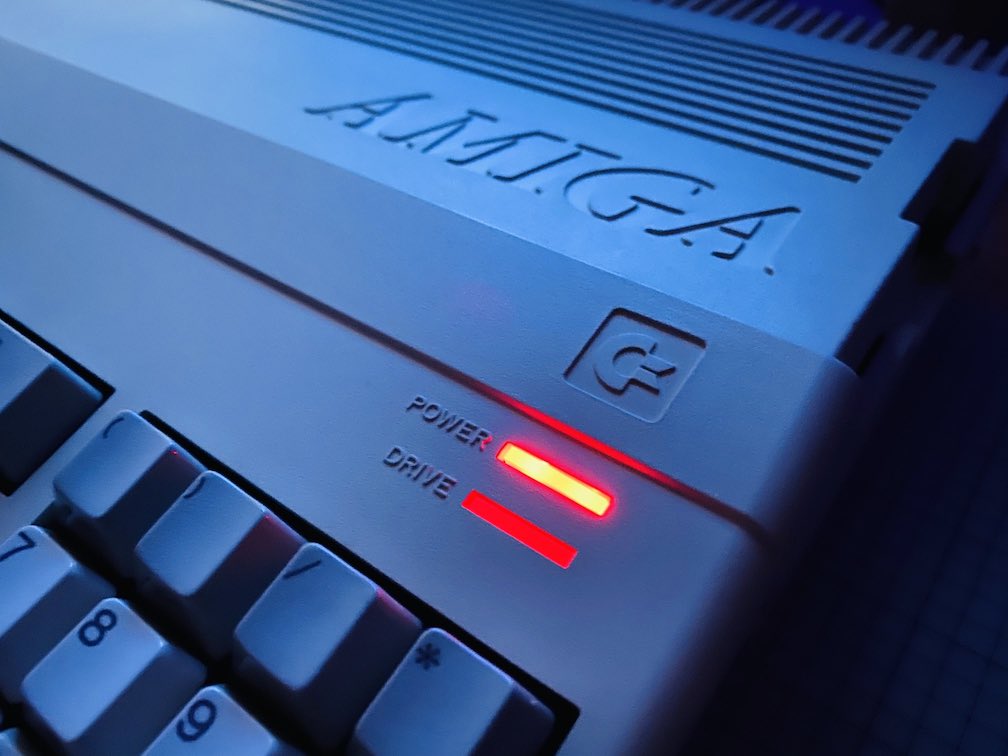
AmigaVision is an open-source configuration package for the MiSTer FPGA Minimig core. It ships a curated setup — drive images, WHDLoad configs, display presets, controller maps — designed to make the Amiga run correctly on modern hardware without requiring that the user already be an expert on the Amiga. It is, depending on your perspective, a convenience layer, a preservation tool, or the thing that stands between a working Amiga and the four-hour configuration spiral that used to be required.
In April 2026, AmigaVision's release thread on the MiSTer FPGA forum documented a fix that deserves more attention than it got. The NTSC pixel-aspect-ratio scaling — the math that determines how non-square Amiga pixels map to modern square-pixel displays — had been wrong. Not a little wrong. Structurally wrong, in a way that had been replicated across emulators and FPGA cores for years.
The bug, in plain geometry
The Commodore Amiga displayed at 320×200 (low-res) or 320×400 (interlaced) in NTSC mode. Those pixels were not square. On a period-correct NTSC CRT, the electron beam painted them at a pixel-aspect ratio (PAR) of roughly 10:11 — slightly taller than they were wide. This is the shape the artists drew for. Every sprite, every background tile, every font character in an NTSC Amiga game assumed 10:11 pixels.
When modern displays — all of which use square pixels — render Amiga output, they need to compensate. Stretch the horizontal axis by the inverse of that ratio, and circles stay circular, and the artist's intent survives. Get the ratio wrong and everything is subtly distorted: circles become ovals, square UI elements go rectangular, character sprites lose their proportions. The distortion is gentle enough that most people don't consciously notice. They just feel, without being able to name it, that something is off.
"The wrongness was so familiar it had become invisible."
The schematic reference here is simple to state and hard to have caught: the Minimig core's NTSC output, as configured by most setup guides and even some emulator defaults, was applying PAR correction as if the Amiga's NTSC timing matched a generic 640×480 NTSC signal. It doesn't. The Amiga's custom chipset (Agnus, Denise, and later the AGA-era Lisa) produced a signal with timing that diverged from the NTSC broadcast standard in specific, documented ways. The horizontal blanking interval was different. The active pixel count per line was different. The result was that the ratio of visible pixel width to scanline height was not the same as a standard NTSC source.
Every emulator that said "correct for NTSC aspect ratio" was correcting to the wrong NTSC aspect ratio. The Amiga's NTSC was not standard NTSC. It was Amiga NTSC. And nobody had propagated that distinction into the default configurations of the tools most people actually use.
The fix, in one commit
The AmigaVision team identified the discrepancy, calculated the correct PAR for the Minimig core's actual output resolution and timing, and updated the MiSTer video configuration accordingly. The release notes in the April forum thread mention it alongside a list of other improvements — new game entries, updated WHDLoad packages, controller refinements. It does not get top billing. It should.
Here's the mechanism mapping, side by side:
Before: MiSTer Minimig core outputs 320×200 NTSC → video scaler applies generic NTSC PAR correction (assumes ~1:1.2 or similar broadcast-derived ratio) → pixels display slightly too tall on a 16:9 or 4:3 panel → every game looks fractionally wrong in a way nobody has a name for.
After: AmigaVision's updated config specifies the correct PAR for the Minimig core's actual signal timing → scaler applies Amiga-specific correction → pixel geometry matches what a 1987 NTSC Commodore 1084 monitor would have shown → artists' circles are circles again.
That's it. A configuration value. One number, adjusted. And the entire NTSC Amiga library looks correct for the first time on FPGA hardware.
Why nobody else fixed it
This is the part that matters for the preservation beat. The NTSC scaling bug was not a secret. Forum threads on MiSTer FPGA boards had circled the issue for years — users posting screenshots of games that "looked wrong," debating whether the problem was the core, the scaler, the display, or their memory. The Amiga community is one of the most technically literate retro scenes on earth. People knew something was off. They lacked a single authoritative fix that could propagate through the ecosystem.
The reason it persisted is structural, not technical. No single entity owns the Amiga display pipeline from core to screen. The Minimig core is maintained by one set of volunteers. The MiSTer scaler firmware is maintained by another. Individual users configure their own video output. Each layer assumes the next one is handling PAR correctly. Nobody coordinates across the full stack. The bug lives in the gap between responsibilities.
"The bug lives in the gap between responsibilities."
AmigaVision is the rare project that does own the full stack — or at least, the full configuration surface. It ships a complete setup, not a component. When something is wrong at the scaler level, AmigaVision can fix it without waiting for a core update or a firmware patch, because it controls the configuration that bridges core output to display input. That's the leverage. Not code. Configuration authority.
The wider pattern
This is not an Amiga-only problem. NTSC pixel-aspect correction is a minefield across the entire retro-gaming preservation stack. The NES, the SNES, the Genesis, the TurboGrafx-16 — every system that output NTSC had non-square pixels, and every emulator and FPGA core that displays those systems on modern panels has to get the PAR right or silently distort the image. Many of them get it wrong, or get it right for the most common resolution mode and wrong for the edge cases.
The MiSTer platform is arguably better positioned than most to solve this, because its scaler is configurable per-core. The Analogue Pocket handles it differently — its display is fixed at 1600×1440 with integer-scaling options — but faces the same underlying question: whose pixel-aspect ratio are you correcting to? The answer varies by system, by region, and sometimes by individual game.
What AmigaVision demonstrated in April is that the fix doesn't require a new core, a hardware revision, or a standards body. It requires someone who understands the full signal chain to sit down and do the math. And then it requires a distribution mechanism that puts the corrected value in front of every user, not just the ones who found the right forum thread.
Credit where it lands
The AmigaVision team doesn't get enough credit for this work. They maintain an open-source project that makes the Amiga accessible on MiSTer without requiring that the user already know how to configure Workbench, assign WHDLoad slaves, or debug video output modes. That alone is a significant preservation contribution — accessibility is preservation, because a platform nobody can set up is a platform nobody will remember.
But the NTSC fix goes further. It corrects the visual record. Every screenshot, every gameplay video, every stream of an NTSC Amiga game on MiSTer that uses AmigaVision's configuration will now show the correct geometry. The historical image — the thing the artist made — is restored. Not by a museum, not by a corporate remaster, not by a platform holder. By a volunteer project that ships a config package for a hobbyist FPGA board.
Thirty years. One number. The pixels are round again.
If you've been running NTSC Amiga games on MiSTer — with or without AmigaVision — compare your output before and after the April update. The difference is subtle. That's the point. The best fixes are the ones you only notice when someone shows you what was wrong.