
The Company That Invented the Wrestling Game Also Invented Double Dragon. Tag Team Wrestling Turns 43 — and Hamster Just Made Sure You Can Play the First Match That Started It All.
Hamster's Arcade Archives release of Tag Team Wrestling dropped this week. It is a 1983 arcade game by Technōs Japan — the same studio that shipped Double Dragon in 1987. That is not trivia. That is a schematic inheritance that almost nobody writing about either game has bothered to trace. The grapple-proximity system that makes Tag Team Wrestling work is the structural ancestor of the grab-and-throw loop that made belt-scroll brawlers a genre. Hamster just put the blueprint back in circulation.
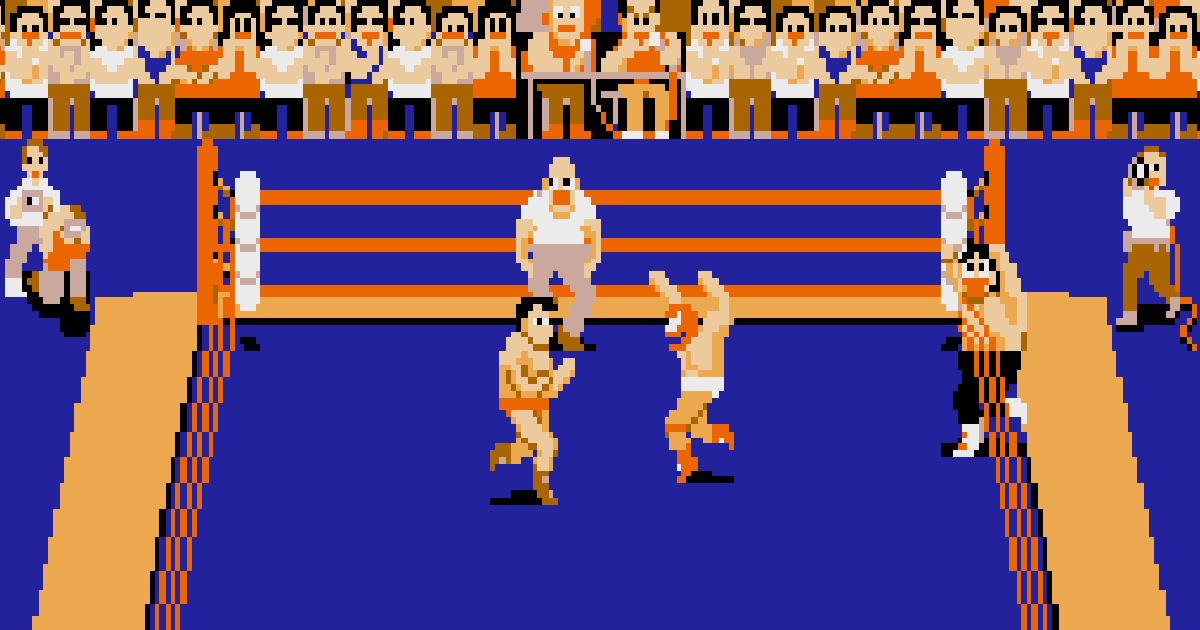
Tag Team Wrestling is a 1983 Technōs Japan arcade game. Per its history, it is widely considered the first dedicated pro-wrestling game — not the first game with wrestling in it (that title gets contested between a handful of pre-1983 oddities), but the first to build its entire cabinet around the sport's ruleset: the ring, the tags, the referee count, the rope bounces, the pinfall win condition. It runs on a simple 6502-based board and renders its two-on-two matches from a fixed overhead-angled view.
The mechanism that matters — the one that travels forward — is the proximity-state toggle. In Tag Team Wrestling, your wrestler has two distinct movesets: a striking set available at range and a grapple set that activates only when you close distance to your opponent. Walk within a specific collision radius and the game swaps your available inputs. Suddenly the punch button becomes a throw. The kick becomes a hold. The entire verb palette changes based on where you are relative to the other body in the ring. This is not a combo system. It is not a special-move input. It is a spatial state machine that uses the distance between two sprites as its only gate.
The schematic reference: Double Dragon, released by the same studio four years later in 1987. Technōs Japan's own lineage makes this explicit — the studio moved from wrestling games through Nekketsu Kōha Kunio-kun (1986) to Double Dragon, and the core designers overlapped across those projects. But the design inheritance is more specific than shared personnel. Double Dragon's grab-and-throw loop runs on the same proximity-state toggle: close the distance to an enemy and your available moves change. The punch button becomes a grab. The grab enables throws, knees, and the shoulder toss. The gate is spatial, not sequential. It is Tag Team Wrestling's ring mechanic, extracted from its sport context and deployed in a street.
The Side-by-Side
In Tag Team Wrestling, the proximity toggle works like this: the player's wrestler approaches the CPU opponent (or the second player's wrestler). At a fixed distance — roughly one sprite-width of separation — the collision state flips. The game reads the same joystick and button inputs differently. A direction-plus-attack that would throw a punch at range now initiates a grapple. Once in the grapple state, the game enters a strength contest: mash the button to overpower your opponent, which determines who executes the throw or hold. The tag partner waits at the corner. Tagging out resets the state. The ring ropes serve as stage boundaries that create bounce trajectories. It is a closed spatial system with one binary gate.
In Double Dragon, Billy and Jimmy Lee walk through side-scrolling streets. Enemies approach. At range, the player has punches and kicks — standard striking inputs. Close the distance and the game flips the same kind of switch. The grab activates. From the grab, the player can throw (directional input + button), knee (repeated button press), or shoulder-toss (specific directional input). The gate is identical: a collision radius that swaps the moveset. The mash mechanic is gone — Double Dragon replaced the strength contest with deterministic input reads — but the structural shape is the same. Approach. Enter proximity. Moveset changes. Execute a throw.
This is not a surface-level resemblance. It is the same state machine with the sport-specific layer peeled off. Tag Team Wrestling needed the mash contest because wrestling is a contest of leverage. Double Dragon dropped it because the power fantasy of a belt-scroll brawler is about efficient violence, not contested holds. But the underlying architecture — "your inputs mean different things depending on your distance from another body" — is a direct transfer.
What the Borrowing Adds
Double Dragon adds scrolling. That sounds obvious, but it transforms the proximity toggle from a ring mechanic into a crowd-management tool. In the ring, you had one opponent at a time (the tagged-in partner). In the street, you have multiple enemies approaching from both sides of the screen. The grab-zone entry becomes a tactical decision: do you close distance to grab this enemy and throw him into the others, or do you maintain range and pick them off with kicks? Tag Team Wrestling's binary toggle becomes a continuous risk calculus when there are five bodies on screen instead of two.
Double Dragon also adds weapons. Bats, whips, knives, oil drums. These are range modifiers — they extend or alter the striking moveset without changing the grab mechanic. The proximity toggle still governs the core close/far split, but now the far state has more variety. It is a design expansion built on top of the original schematic, not a replacement of it.
What the Borrowing Loses
The tag mechanic. Tag Team Wrestling's most distinctive contribution to its own genre — the ability to swap between two wrestlers, each with slightly different stats — does not survive the transfer. Double Dragon's two-player mode is simultaneous, not sequential. Both Lees are on screen at once. There is no rest state, no corner to retreat to, no strategic decision about when to swap. The tag was the closest thing 1983 arcade design had to a resource-management layer, and Double Dragon abandoned it entirely.
It also loses the sport framing, and this matters more than it sounds. Tag Team Wrestling has a referee. It has a three-count pin. It has win conditions that are not "the other guy's health bar hit zero." The referee is a third agent in the system — a timer, a rule enforcer, a source of dramatic tension when you get the pin at two-and-a-half. Belt-scroll brawlers would not rediscover the value of a third-party agent in the combat space for years. The referee was doing something structurally interesting, and the genre that inherited the rest of the schematic left it on the floor.
What It Doesn't Quite Earn
The proximity toggle, for all its importance, is not mechanically deep in Tag Team Wrestling. The grapple state resolves through button mashing — a strength contest that rewards endurance over timing or positioning. Double Dragon refined this by making the grab-state moves deterministic: the player inputs a direction, the game executes the corresponding throw. That is a genuine improvement. But Double Dragon doesn't push the proximity toggle much further than "grab near, punch far." The belt-scroll genre would iterate on this for a decade — Final Fight's grab-walk, Streets of Rage 2's directional throws, Guardian Heroes's RPG-stat gating on grapple success — but the original Double Dragon inherits the toggle and mostly stops there.
The Arcade Archives release makes this traceable in a way that YouTube footage and Wikipedia summaries don't. Per Time Extension, Tag Team Wrestling is this week's Arcade Archives drop. Per Netto's Game Room, the release preserves the original ROM behavior — Hamster's standard practice, which is the whole reason Arcade Archives matters as a preservation project. The game is playable on current hardware, in its original form, with its original input behavior intact. That means the proximity toggle is observable. The state change is not described in a manual or inferred from a video — it is mechanically present in a game you can buy for a few dollars on a modern console.
Technōs Japan is gone. The studio closed in 1996. Its intellectual property passed through several hands; per its corporate history, Arc System Works acquired a significant portion of the Technōs catalog, including Double Dragon and the Kunio-kun franchise. Arc System Works has built new Double Dragon entries — Double Dragon Gaiden: Rise of the Dragons shipped in 2023 — but the studio's preservation of the earlier Technōs catalog, the pre-Double Dragon work, has been quieter. It is Hamster Corporation, not Arc System Works, that just made the schematic's origin point commercially available again.
"The grab-and-throw loop that defined an entire genre started in a wrestling ring. Four years before Billy Lee threw his first elbow, two unnamed wrestlers were toggling the same state machine."
This is what Arcade Archives does at its best: it makes design lineage physically playable. Not described. Not cited. Playable. The proximity toggle in Tag Team Wrestling is a small, binary thing — you're close enough or you're not — but it is the exact mechanism that Double Dragon promoted to genre-defining status. Without the Arcade Archives release, that connection lives only in text. With it, you can feel the state change in the same input language the designers used to prototype the idea that became the brawler.
Tag Team Wrestling is the schematic. Double Dragon is the product. The same studio drew both. The proximity-state toggle — the idea that your distance from another body changes what your buttons do — travels from a 1983 wrestling ring to a 1987 street fight without modification to its core logic. Technōs Japan invented the wrestling game and invented the belt-scroll brawler, and they are the same invention, applied twice.
If this lineage traces further than we've drawn it — if you know the pre-1983 wrestling games that might have a proximity toggle buried in their code — tell us. The schematic is never as simple as one origin.