
Sega Canceled It in 1994. Brazil Just Built It in FPGA. The GF1 Neptune Is Running 32X Games.
The Sega Neptune was a combined Genesis and 32X in a single housing. Sega announced it, priced it at $200, and canceled it before a single unit shipped. Thirty-one years later, Brazilian FPGA studio GamesCare has built the thing Sega abandoned — from scratch, in programmable logic — and it is running 32X games on real hardware. The GF1 Neptune is not emulation. It is a gate-level reconstruction of a console that never existed.
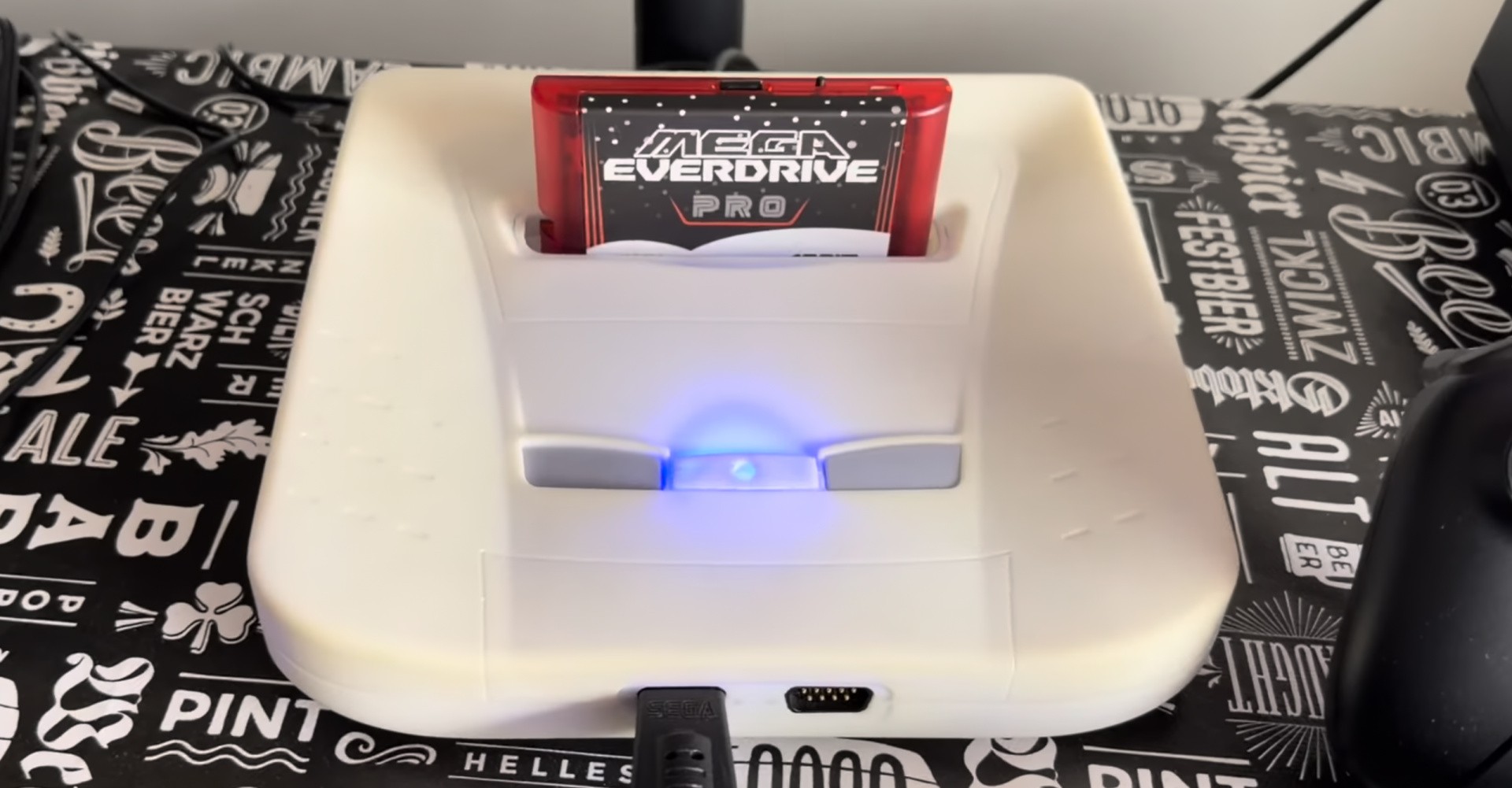
The ghost console
The Sega Neptune is one of the most famous pieces of hardware that never existed. In late 1994, Sega of America announced a standalone unit that would merge the Mega Drive (Genesis in North America) and the 32X add-on into a single integrated console. The pitch was clean: one box, one power supply, no mushroom adapter sitting on top of your Genesis like a second head. Per Time Extension, Sega showed it at Winter CES 1995, priced it at $200, and assigned it a model number. Then the Saturn arrived, the 32X collapsed under the weight of Sega's own competing priorities, and the Neptune was quietly canceled. No production run. No retail units. No silicon in anyone's hands.
What the Neptune represented, though, was architecturally interesting in a way that the 32X alone never quite got credit for. The 32X added two Hitachi SH-2 processors running at 23 MHz to the Genesis's Motorola 68000 and Zilog Z80. That is not a graphics accelerator bolted onto a 16-bit bus — it is a genuinely hybrid architecture, two 32-bit RISC CPUs negotiating with a 16-bit host system through shared memory and an awkward but functional video overlay pipeline. The Neptune would have been the first (and only) console to ship that full stack in a single housing.
It never got the chance. Until now.
What GamesCare built
Per Time Extension's May 2026 report, Brazilian FPGA studio GamesCare has demonstrated the GF1 Neptune running 32X software. This is not software emulation — the GF1 Neptune is an FPGA-based device that reconstructs the Neptune's combined architecture in programmable logic. The Mega Drive core and the 32X core operate in tandem on the same FPGA fabric, communicating through the same bus topology that Sega's unreleased hardware would have used.
The key detail: the 32X core is running. Time Extension's coverage shows the device executing 32X game software, which means the dual-SH-2 pipeline, the Genesis-side 68000, the Z80 sound subsystem, and the video overlay path between the two halves of the architecture are all functional enough to boot and run commercial titles. That is a significant engineering milestone. The 32X's interaction with the Genesis host is one of the more complex bus-negotiation problems in the 16/32-bit era — the two systems share a video output path where the 32X composites its framebuffer over the Genesis VDP's output, a pipeline that has caused headaches for software emulators for decades.
"Greetings straight from the 32-bit era" — the GF1 Neptune is a gate-level answer to a question Sega asked in 1994 and never answered.
GamesCare announced the GF1 Neptune project in late 2025. Per Time Extension's December 2025 report, the team initially targeted a late-2025 release but pushed the timeline into 2026, citing the need to get the 32X integration right. Their statement at the time: "We believe this is the right step." The implication was clear — shipping a Mega Drive FPGA clone without the 32X half would have been just another Genesis-on-FPGA project. The Neptune name demands the full stack.
Why this matters beyond the novelty
There is a version of this story that is pure nostalgia: "cool, someone built a thing that Sega canceled." That version is fine, but it misses the structural point.
The 32X has one of the worst reputations of any commercial gaming hardware. It sold poorly. It had a short library. It was immediately overshadowed by the Saturn. The consensus narrative — the one that shows up in every retrospective — is that the 32X was a mistake, a stopgap, a symptom of Sega's internal dysfunction. And that narrative is not wrong on the business level. But it has had a corrosive side effect: the 32X's technical work has been treated as disposable too. Its games are under-preserved, under-emulated, and under-studied relative to its contemporaries.
FPGA reconstruction changes the terms. When GamesCare builds a gate-level 32X core that runs on real hardware, they are making an argument that the architecture was worth preserving — not because the console succeeded commercially, but because the engineering had ideas in it. The dual-SH-2 pipeline, the video overlay compositing, the shared-memory negotiation between a 16-bit host and 32-bit guests — these are design decisions that deserve to survive the business failure that buried them.
The 32X library is small — roughly 40 titles across all regions. Some of those titles are genuinely interesting technical showcases. Some are quick ports. The point is that the FPGA reconstruction makes the entire library playable on purpose-built hardware for the first time since the original units were manufactured, and does so without the reliability problems that plague aging 32X units (the original hardware's ribbon cables and capacitors are notorious failure points).
The team
GamesCare operates out of Brazil and has been working in the FPGA console space for several years. The GF1 Neptune is their flagship project — the one that carries the most architectural ambition and the most complex integration challenge. The fact that the team chose to reconstruct a canceled console rather than clone an existing one tells you something about their priorities. They are not building a nostalgia box. They are answering a historical question: what would the Neptune have been?
The FPGA scene is not short on Mega Drive / Genesis implementations. MiSTer has a well-regarded Genesis core. Analogue's Mega Sg handles the 16-bit side cleanly. But none of those projects include an integrated 32X core running alongside the Genesis core in the same device. The GF1 Neptune is, as far as public documentation shows, the first FPGA implementation to unify both halves of the Neptune architecture on a single platform. That is the claim that justifies the name.
FPGA as historical argument
Lumenforce has a position on this: FPGA and ASIC are both valid answers to the preservation question, and neither obsoletes the other. The GF1 Neptune is a strong case for the FPGA side of that argument — not because it is "better" than software emulation of the 32X (both approaches have trade-offs), but because FPGA reconstruction makes a different kind of claim. Software emulation says: "we can approximate the behavior." FPGA reconstruction says: "we can rebuild the logic." When the subject is a console that never shipped, the FPGA approach is especially resonant — there is no original behavior to approximate, only an architecture to reconstruct from documentation, die shots, and reverse engineering.
GamesCare's work also sits in an interesting relationship with the broader FPGA console scene. The MiSTer project has demonstrated, across dozens of cores, that community-driven FPGA development can reconstruct commercial hardware with remarkable fidelity. But MiSTer cores run on a general-purpose FPGA platform — the DE10-Nano board and its surrounding ecosystem. The GF1 Neptune is a purpose-built device: custom PCB, dedicated form factor, designed from the ground up to be the Neptune that Sega never shipped. That is a different kind of commitment. It is hardware as thesis statement.
When the subject is a console that never shipped, FPGA reconstruction is not preservation — it is completion.
What's next
The GF1 Neptune's 32X core is running, but the project is not finished. Per Time Extension's December 2025 coverage, GamesCare pushed the project into 2026 specifically to ensure the 32X integration met their standards. The May 2026 demonstration shows functional 32X game execution, but the gap between "running" and "shipping" is where the hard compatibility work lives — edge cases in the SH-2 pipeline, timing-sensitive games that depend on specific bus arbitration behavior, the video overlay path's handling of every resolution and color-depth combination the 32X library uses.
The questions worth tracking: What is the final compatibility rate across the 32X library? Does the Genesis side of the architecture maintain cycle accuracy when the 32X cores are active and competing for bus time? What FPGA fabric are they targeting, and does it have the logic-element headroom to handle the full Neptune stack without compromises? GamesCare has not published detailed technical specifications yet. When they do, the answers will determine whether the GF1 Neptune is a proof-of-concept or a definitive platform.
Sega canceled the Neptune because the Saturn made it redundant before it shipped. Thirty-one years later, a team in Brazil decided the question was still worth answering. The GF1 Neptune is running. The ghost has a body now.
Follow the project: GamesCare's GF1 Neptune updates are tracked by Time Extension. We will cover the next milestone when GamesCare publishes compatibility data or announces shipping dates.