
Bloodstone Pushes the 128K Spectrum Into Gothic Platformer Territory
Publisher ZXOnline has launched Bloodstone, a gothic action-platformer designed exclusively for the 128K ZX Spectrum. Built by Romancha, Jerri, and DaRkHoRaCe, the game casts you as Kamran the Furious — a fighter whose father Istvan sacrificed himself to cast a spell that left Kamran technically undead but still aligned with the Light. Moonlit castles, high-contrast forests, a $7 price tag. The modern Speccy homebrew scene has been turning out serious work for years now, but early adopters are already calling this one game of the year.
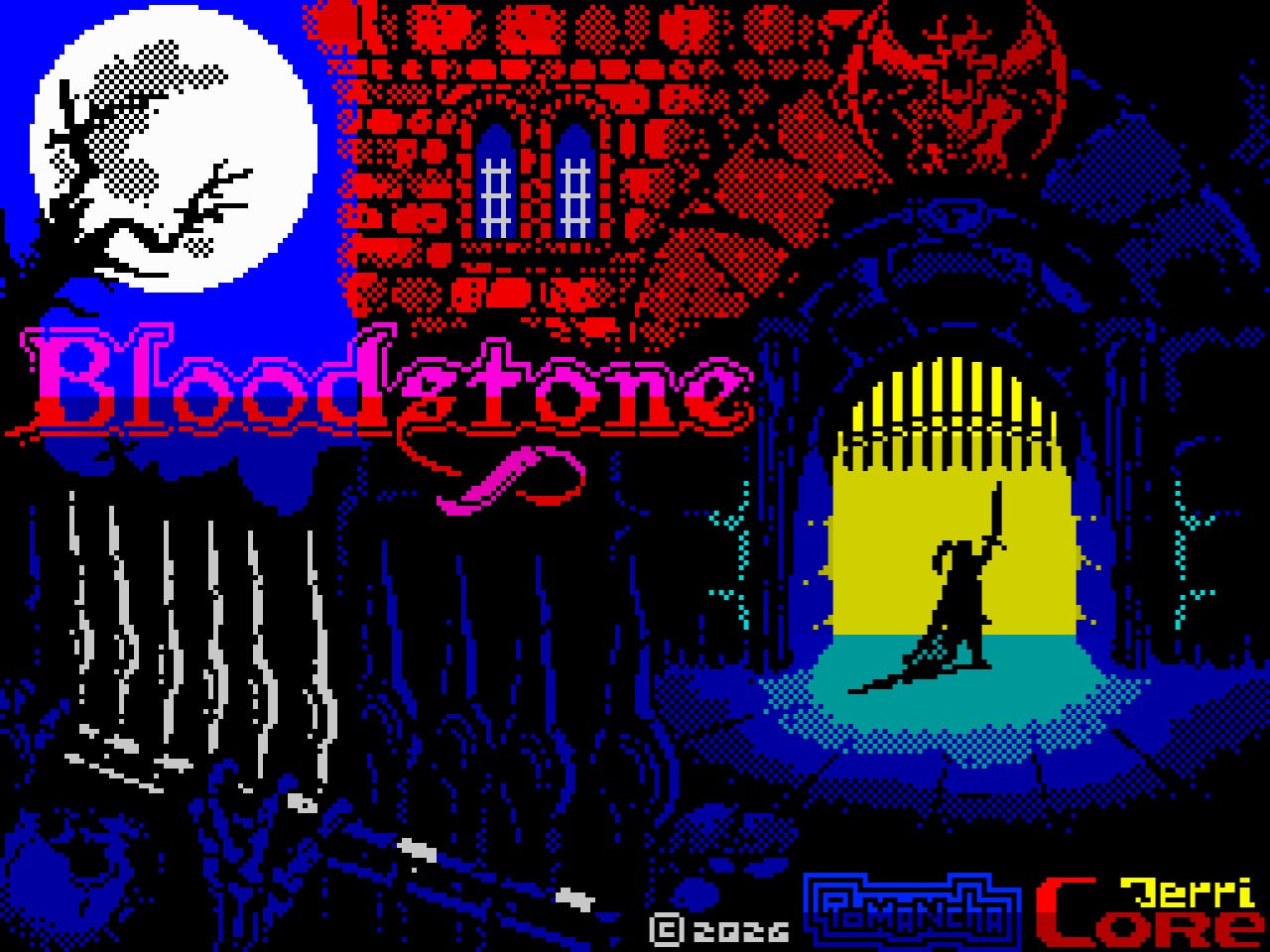
The ZX Spectrum homebrew scene does not need your pity. It has not needed it for a long time. What it produces, week after week, is a stream of original software for a machine that left commercial production in 1992 — and the quality curve has been climbing. Bloodstone, published by ZXOnline and developed by the team of Romancha, Jerri, and DaRkHoRaCe, is the latest argument that this community is making things other communities talk about making.
The first thing to understand about Bloodstone is what it refuses. It does not target the 48K Spectrum. It is designed exclusively for the 128K model — the expanded-RAM variant Sinclair launched in 1985 — and it uses every byte of the difference. That choice is not neutral. A 48K-compatible release reaches more emulators, more hardware, more people. A 128K-only release is a declaration: this game needs more memory than the base machine offers, and we are not going to pretend otherwise.
What does the extra memory buy? Atmosphere. Bloodstone's visual setting is high-contrast gothic imagery: a forest, a castle overshadowed by moonlight, a lone figure moving through darkness. The Spectrum's famous color-clash limitations are still present — two colors per 8×8 cell, forever — but the art direction works with the constraint rather than against it. High-contrast palettes on the Spectrum look deliberate when the subject matter is already built on shadow and silhouette. Moonlight through a castle window doesn't fight the attribute grid. It lives inside it.
Moonlight through a castle window doesn't fight the attribute grid. It lives inside it.
The narrative is operatic in the way good dark fantasy always is. You play as Kamran the Furious, a fighter who should be dead. His father Istvan sacrificed himself to cast a unique spell — one that left Kamran technically undead but able to remain on the side of Light. That premise does a lot of structural work: it gives the player-character a reason to be powerful, a reason to be fragile, and a reason to keep moving forward. Legacy. Sacrifice. The supernatural. The game wears its themes openly, and on a machine with limited narrative bandwidth — no voice acting, no cutscene engine — that directness is a strength.
Mechanically, Bloodstone is an action-platformer with a control scheme that suggests real thought about how a Spectrum keyboard feels under your fingers. Default bindings include Q + Enter for a fire spell attack, Enter alone for a sword strike, and A + Enter for a shield block. Kempston joystick is supported. Keys are redefinable from the settings menu before you start — a small quality-of-life decision that matters more than it sounds, because Spectrum keyboards vary wildly across original hardware, clones, and USB replicas. Giving the player the rebind option is the 128K-era equivalent of a full accessibility menu. It says: we know who's playing this, and we care how.
The team behind the game deserves individual credit. Romancha handles the core development. Jerri contributed to the project's visual and design work. DaRkHoRaCe — a name known in the Speccy scene — rounds out the trio. These are not anonymous hobbyists. They are named people making finished, commercial-grade software for a platform that major publishers abandoned three decades ago. The Spectrum homebrew community treats its developers like craftspeople, because they are.
Distribution follows the model that has quietly become standard for high-end Speccy homebrew. Bloodstone is available through ZXOnline's catalog and through itch.io at a price of $7 — positioned clearly as a paid release, not a donation-optional freeware drop. The licensing model is described as "the 90's Era" license: you support the authors by paying for the pleasant emotions of nostalgia. That framing is self-aware without being ironic. It names the transaction honestly — you're paying for craft, for feeling, for the labor of people who chose to build something new on something old.
The early response has been warm and specific. Indie Retro News covered the launch with praise for its visual quality and atmospheric storytelling. Comments from early players include unhedged declarations of "Game of the Year" — which, in a community that ships dozens of original titles annually, is not throwaway enthusiasm. The modern Speccy scene has its own internal critical culture, its own taste hierarchies, its own sense of what a platform-defining release looks like. When that community calls something a contender, the call is coming from people who play everything the platform produces.
What makes Bloodstone worth noting beyond its own merits is the choice it represents. The 128K-only decision is a line in the sand. Homebrew developers on legacy platforms face a constant tension between reach and ambition — do you ship something that runs on every variant of the hardware, or do you target the high-end model and use the room? Bloodstone picks ambition. It bets that the audience for a polished 128K Spectrum platformer in 2026 is large enough, engaged enough, and willing enough to pay $7 for a game that could not exist on the lesser machine.
That bet looks good. The Spectrum homebrew community is not shrinking. It is not coasting on sentiment. It is producing work that meets or exceeds the best commercial releases the platform ever saw — and charging for it, and finding buyers. Bloodstone is the latest evidence, but it will not be the last. Kamran the Furious is technically undead. So is the ZX Spectrum. Both seem to be doing fine.
Have you played Bloodstone, or is there a 2026 Spectrum homebrew release we should cover? Rejected Coins tracks the retro homebrew scene as seriously as anything shipping on current hardware. Reach us through the site.