
Before Dragon Quest, Before Final Fantasy: The Dungeon That Built Everything
In 1981, Sir-Tech Software published Wizardry: Proving Grounds of the Mad Overlord on the Apple II. It sold a quarter-million copies before most Americans had a home computer. Yuji Horii played it and made Dragon Quest. Hironobu Sakaguchi played it and made Final Fantasy. The entire JRPG lineage — party formation, turn-based combat, dungeon cartography, experience curves — traces back to a six-character party walking blind into a ten-level wireframe dungeon coded in a dorm room in upstate New York. Now Atari owns the rights to the original Llylgamyn saga, and Digital Eclipse has already proved what a careful restoration looks like. The question is whether ownership means preservation — or just another logo on the box.
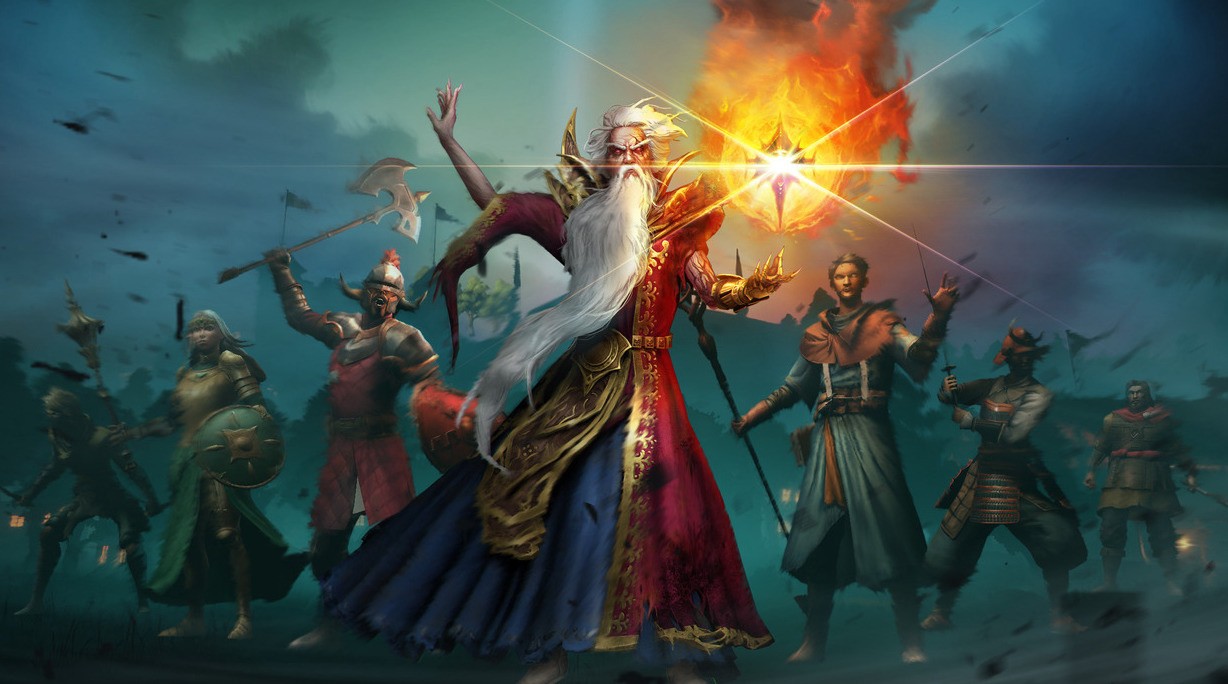
There is a room on the first floor of the dungeon beneath Trebor's castle. You turn a corner and the wireframe walls redraw. A message appears: you have encountered a group of enemies. You have no minimap. You have no quest marker. You have a six-character party you rolled by hand, a sheet of graph paper you're filling in yourself, and the absolute certainty that if your entire party dies, they are dead. Not "reload from checkpoint" dead. Dead dead. The save file knows. The floppy disk remembers.
The game is Wizardry: Proving Grounds of the Mad Overlord, published by Sir-Tech Software in 1981. It was designed by Andrew Greenberg and Robert Woodhead, two Cornell students who had been playing Dungeons & Dragons on the university's PLATO mainframe system and decided to write their own dungeon crawler for the Apple II. The result was not just a game. It was a schematic — a blueprint so cleanly drawn that designers on two continents spent the next decade building on top of it.
And on May 6, 2026, Atari acquired the rights to the original Llylgamyn saga — Wizardry I through V, plus the ancillary IP. The press release talks about "legendary" and "iconic." It does not talk about what the dungeon actually did.
The schematic
Here is what Wizardry codified, in 1981, on a machine with 48 kilobytes of RAM:
Party formation with class interdependence. You rolled six characters from five races and eight classes. A party of six fighters would die. A party without a priest would die slower but still die. The game forced you to think about composition before you ever set foot in the dungeon. This is the template. Dragon Quest III (1988) adopted it almost structurally intact. Final Fantasy (1987) gave you four slots instead of six, but the class matrix — fighter, black mage, white mage, thief — maps directly onto Wizardry's fighter, mage, priest, thief.
First-person dungeon exploration on a grid. The ten floors of Trebor's dungeon were laid out on a strict Cartesian grid. You moved in four cardinal directions, one step at a time. The screen rendered a wireframe perspective view of the corridor ahead. No texture mapping. No skybox. Just lines on black, and the knowledge that the next step forward might drop you into a chute, teleport you to a different floor, or trigger an encounter with enemies scaled to murder a mid-level party. The spatial logic — grid-based, first-person, navigated by memory and graph paper — would be inherited directly by Megami Tensei (1987), the Etrian Odyssey series (2007–), and the entire "dungeon crawler" genre that Japan refined into an art form across the next four decades.
Turn-based combat with per-character commands. Each round, you issued orders to all six party members before combat resolved. Front-row characters could melee; back-row characters could cast or use items. Enemy groups had their own formation logic. This is the mechanical ancestor of every JRPG battle system that asks you to choose FIGHT / MAGIC / ITEM / RUN from a menu. The menu is Wizardry's menu. It just looks different now.
Permadeath and persistent consequences. Dead characters could be resurrected at the temple in town — for a fee, and with a chance of failure that could turn them to ash. Ashed characters could be resurrected too, but failure meant permanent deletion. The game saved to disk constantly. There was no reverting. This brutality was the point: it made every decision feel real, every dungeon floor a genuine expedition. When JRPGs softened permadeath into "game over, continue?" screens, they were responding to Wizardry's design — not ignoring it but consciously deciding how much consequence a wider audience could bear.
"The floppy disk remembers. There was no reverting. This brutality was the point."
The bridge to Japan
The American RPG market in 1982 was Wizardry and Ultima, and then it was mostly Ultima. Richard Garriott's open-world design — the overworld map, the towns, the narrative freedom — appealed to American tastes more durably. Wizardry's sales were enormous at first (over 200,000 copies in its first two years, on a platform with a relatively small installed base) and then declined as the series grew more punishing and niche through sequels II through V.
In Japan, the opposite happened. Wizardry was localized for the PC-88 and PC-98 in 1985, and it detonated. The game became a phenomenon — not a niche one, a mainstream one. ASCII Corporation published it. It sold massively. It spawned Japanese-developed spin-offs, manga adaptations, and an entire subculture of graph-paper dungeon mappers that persists to this day.
As Vice's coverage notes, the influence on Yuji Horii was direct and acknowledged. Horii has spoken publicly about playing Wizardry and Ultima before designing Dragon Quest (1986) for the Famicom. He took Wizardry's party mechanics and Ultima's overworld structure and fused them into something a console audience could navigate with a d-pad. Hironobu Sakaguchi's Final Fantasy (1987) drew from the same well — the four-member party, the class system, the turn-based combat flow. The debt is structural, not cosmetic. These are not games that were "inspired by" Wizardry the way a painter is "inspired by" a sunset. They are games that reverse-engineered its mechanical logic and rebuilt it for new hardware.
This is the part the Atari press release does not say: Wizardry is the most influential RPG ever made, and it is the most influential RPG ever made primarily because of what Japanese designers did with it. The game's legacy is not in Rochester, New York, where Sir-Tech was based. It is in Tokyo, Osaka, and Kyoto, in the design DNA of franchises that collectively generated tens of billions of dollars in revenue.
"Horii took Wizardry's party mechanics and Ultima's overworld and fused them into something a console audience could navigate with a d-pad. The debt is structural, not cosmetic."
The side-by-side
Line them up. It's instructive.
Wizardry (1981): Roll party → enter dungeon → first-person grid movement → random encounter → turn-based combat (front row melees, back row casts) → earn XP → level up → gain spells by level threshold → return to town to heal/save → descend deeper.
Dragon Quest (1986): Create hero → enter overworld → random encounter → turn-based combat (single character, later party) → earn XP → level up → learn spells by level threshold → return to town to heal/save → explore further.
Final Fantasy (1987): Choose four party members from six classes → enter overworld → random encounter → turn-based combat (front row melees, back row casts) → earn XP/Gil → level up → buy/learn spells → return to town → advance narrative.
The skeleton is the same skeleton. Horii simplified it for a single protagonist and a mass-market console. Sakaguchi kept the party structure and added narrative scaffolding. But the core loop — the enter-fight-earn-return-descend loop — is Wizardry's loop. Every JRPG that followed inherited it, modified it, iterated on it, subverted it. The loop is still running. Persona 5 is still running it. Octopath Traveler is still running it. The wireframe corridor just has more polygons now.
What Atari bought
Atari's acquisition covers the original Llylgamyn saga — the five games that Greenberg, Woodhead, and later collaborators built at Sir-Tech between 1981 and 1992. This is not the entire Wizardry franchise; the Japanese-developed titles (including the well-regarded Wizardry: Labyrinth of Lost Souls and the 2024 remake by Digital Eclipse) have their own rights structures. But it is the headwaters. The original code. The original dungeon.
Digital Eclipse's 2024 remake of Proving Grounds of the Mad Overlord already demonstrated what respectful stewardship looks like: faithful mechanical recreation with modern quality-of-life concessions, packaged with historical context and original documentation. That game exists. It was well-received. It proved the concept.
The question now is what Atari does with the IP beyond that. Time Extension's reporting contextualizes the acquisition within Atari's broader retro-IP strategy — a strategy that has been, to be generous, inconsistent. Atari has bought a lot of legacy brands. Not all of them have been handled with the care the original creators would recognize.
Wizardry is not a brand to put on a t-shirt. It is a design document. It is the mechanical blueprint that an entire genre was built from. If Atari understands that — if they treat the Llylgamyn saga as a primary source document for RPG history and make it permanently, legally, accessibly available — then the acquisition is a preservation event. If they sit on it, license it for a mobile gacha tie-in, or let it gather dust in a rights portfolio, then they have purchased the headwaters of a river and dammed them.
The graph paper is the map
Here is what stays with me about Wizardry, forty-five years later. It trusted the player to bring the map. The game did not draw one for you. You drew it yourself, on graph paper, one square at a time, and when you got it wrong — when you missed a one-way door or forgot to mark a teleporter — you died in the dark. The game's cruelty was a kind of respect. It assumed you were serious. It assumed you were paying attention. It assumed the dungeon mattered enough to draw.
Every automap in every JRPG since is a response to that assumption. Some games kept it — Etrian Odyssey made the DS touchscreen into graph paper and asked you to draw the map yourself, a direct homage forty-three years and six hardware generations deep. Most games abandoned it, replaced it with fog-of-war automaps and waypoint markers, and that's fine. Design evolves. Audiences expand. But the original proposition — that the dungeon is a real place you have to learn with your hands — that's Wizardry's proposition. It was true in 1981. It is true when you boot the Apple II version today.
Andrew Greenberg and Robert Woodhead wrote a dungeon that taught an industry how to build worlds. The worlds got bigger, more colorful, more forgiving, more profitable. The dungeon stayed the same: ten floors, wireframe walls, a party of six, and a floppy disk that remembered everything you did.
"The game's cruelty was a kind of respect. It assumed the dungeon mattered enough to draw."